
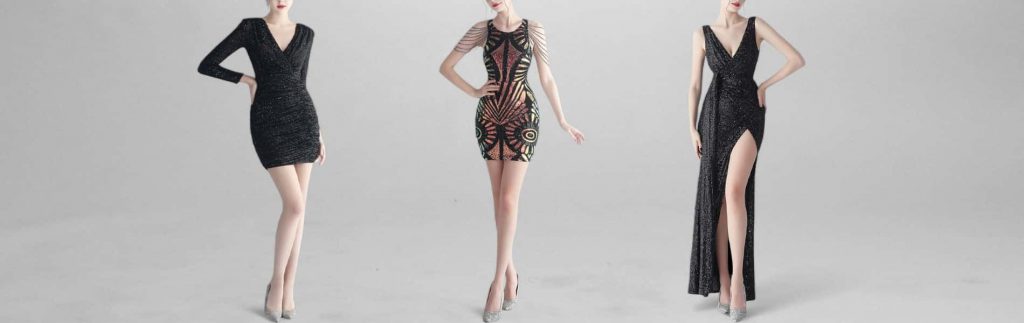
Quick answer: A dress can cost anywhere from about $8 to $150+ to manufacture depending on fabric, lining, construction complexity, trims, embellishment, order quantity, and whether the style is a simple shift dress, casual dress, or evening gown.
Dresses present unique manufacturing challenges compared to separates. The wide variety of styles, fabrics, and construction methods creates enormous cost variations. A simple shift dress might cost $8-12 to produce, while an elaborate evening gown can run $60-150 or more.
Understanding these cost drivers helps you build a dress line that balances quality, pricing, and profitability.
Fabric Costs: The Foundation of Dress Production
Fabric dominates your production budget for dresses. A simple shift dress requires 1.5-2.5 yards of fabric, while a maxi dress with gathering can demand 4-6 yards.
Basic cotton poplin or jersey costs $3-6 per yard wholesale. Mid-range fabrics like rayon challis or ponte knit run $6-12 per yard. Premium materials like silk crepe de chine cost $15-30 per yard, while specialty weaves can reach $25-50 per yard.
Lined dresses require additional fabric. Lining adds $1.50-4 per dress depending on style and material quality.
Fabric Selection Impact on Costs
Different fabrics require different construction techniques and skill levels. Woven fabrics need finished seams, adding labor time. Delicate materials like silk demand experienced operators who work slowly to avoid damage. Print placement also impacts costs—engineered prints create waste that increases yardage requirements by 15-30%.
Labor and Construction Costs by Dress Style
Labor costs vary more for dresses than perhaps any other garment category. A basic t-shirt dress might require 15-20 minutes of sewing time, while a structured fit-and-flare dress could take 45-75 minutes.
Domestic production in the United States typically costs $12-35 per dress for labor. Simple styles sit at the lower end, while intricate construction pushes costs higher. Overseas manufacturing in Vietnam, Bangladesh, or China reduces labor to $3-15 per dress.
Construction details that increase labor costs include invisible zippers, princess seams or complex bodice construction, full lining, hand-finishing details like bound buttonholes, and pleating or gathering. Each of these elements improves the finished product but also increases production time and cost.
Production Cost Comparison by Style
| Dress Style | Fabric Cost | Labor Cost | Additional Costs | Total Production Cost |
| Basic T-Shirt Dress | $5-10 | $3-8 | $1-2 | $9-20 |
| Casual Midi Dress | $10-18 | $6-12 | $2-4 | $18-34 |
| Structured Work Dress | $15-25 | $10-18 | $3-6 | $28-49 |
| Evening/Cocktail Dress | $25-50 | $15-30 | $5-12 | $45-92 |
These figures assume mid-volume production of 300-800 units. Smaller quantities increase per-unit costs by 35-50%, while orders exceeding 2,000 units can reduce costs by 20-30% through economies of scale and better fabric pricing.
Hardware, Notions, and Trim Costs
While dresses generally require less hardware than pants or jackets, these components still add up. Zippers range from $0.60 for basic nylon to $3-5 for invisible or premium metal options. Buttons cost $0.10-0.80 each for basic styles, while specialty buttons run $0.50-3 each.
Thread costs $0.30-0.75 per basic dress, while complex styles with extensive topstitching can use $1-2 worth. Elastic for waistbands adds $0.25-0.75 per dress.
Decorative elements dramatically impact costs. Lace trim costs $1-8 per yard, with each dress potentially requiring 1-5 yards. Embroidery ranges from $2-15 per dress based on stitch count. Beading or sequins can add $5-30 for minimal embellishment or $50-200+ for heavily decorated pieces.
Hidden Costs That Affect Your Bottom Line
Pattern development for dresses costs $400-1,200 per style. Grading across sizes adds $150-500, while creating fit samples costs $60-180 each. Expect to produce 3-5 samples before finalizing most dress designs.
Packaging requirements vary by distribution channel. Simple poly bags cost $0.15-0.35 per dress, while premium brands using boxes with tissue paper spend $2-8 per dress. Hangers add $0.25-0.90 for retail distribution.
Quality control costs $0.60-2 per dress but prevents returns and maintains brand reputation. Dresses have higher return rates than separates, making quality investment essential. Labels and hang tags contribute $0.40-1.50 per dress depending on quantity and customization.
Factors That Drive Production Costs
Design complexity creates the single biggest cost variable in dress manufacturing. The number of pattern pieces directly correlates with production time and cost—a simple two-piece dress costs significantly less than a dress with 12+ pattern pieces.
Fabric choice impacts more than just material costs. Delicate fabrics require experienced operators who work more slowly. Slippery materials like silk need special techniques. Sheer fabrics often require lining, doubling material requirements.
Fit precision affects labor costs substantially. Loose, relaxed silhouettes allow more tolerance and use less skilled labor. Fitted styles require precise seam alignment and careful pressing, increasing production time by 30-50%.
Length and volume matter significantly. A mini dress uses half the fabric of a maxi dress. Full skirts with gathering consume more fabric than straight silhouettes.
Smart Cost Optimization Strategies
Strategic fabric selection balances cost and quality. Starting with stock fabrics eliminates minimums and reduces lead times. Many mills maintain excellent fabric libraries for diverse style needs.
Simplifying construction reduces costs without sacrificing style. Using straight seams instead of curved princess seams saves time. Choosing exposed zippers cuts labor. Eliminating full lining on casual styles reduces material costs—potentially cutting production by 20-40%.
Standardizing sizing to industry measurements saves $300-600 per style. Most successful brands offer 4-6 sizes rather than 8-10 from launch. Limiting color options to 2-3 per style reduces inventory complexity.
Here are the key cost-saving approaches that work for dress manufacturing:
- Design with manufacturing efficiency in mind—fewer seams and simpler construction
- Use stock fabrics to avoid custom minimums and reduce lead times
- Standardize sizing to industry measurements to minimize pattern costs
- Start with limited color options and expand based on proven demand
- Consider semi-lining instead of full lining where appropriate
- Choose appropriate fabric weights that don’t require special handling
Minimum Order Quantities and Volume Impact
Dress manufacturers typically require MOQs of 300-600 pieces per style. Simple jersey dresses might have lower minimums of 200-300 pieces, while complex styles require 500-800 pieces.
Fabric purchasing often drives MOQ requirements. Mills may require 500-1,500 yard minimums per fabric/color. Production volume dramatically affects costs—producing 100 versus 1,000 dresses can nearly double your per-unit cost.
Calculating Retail Pricing for Dresses
Standard retail markup follows the keystone method—doubling wholesale price for retail. A dress costing $20 to produce wholesales for $40 and retails for $80-90.
Designer dresses can retail at 8-12x production cost when brand positioning justifies premium pricing. Direct-to-consumer brands eliminate wholesale margins—a $25 production cost dress might retail for $75-95 DTC versus $120-150 through traditional retail.
Working with the Right Manufacturing Partners
Dress manufacturing requires different expertise than other garment categories. Fashion Atlas Group connects brands with dress manufacturers across all price points and style categories, from casual jersey dresses to formal evening wear.
Ready to Launch Your Dress Line?
Understanding production costs is just the beginning. Successfully manufacturing dresses requires navigating fabric selection, construction methods, and quality control. The decisions you make about design and manufacturing partners determine both your costs and product quality.
Contact Fashion Atlas Group today to discuss your dress collection. Our team helps you understand specific production costs for your designs, recommends strategies to optimize value, and connects you with manufacturers who match your vision and budget.
Schedule your free consultation now and discover how we can help you produce beautiful dresses at competitive costs.
FAQ
What is the average cost to make a dress?
A simple dress may cost around $8-20 to manufacture, while lined dresses, premium fabrics, complex silhouettes, and evening styles can cost $60-150 or more.
Why do dress production costs vary so much?
Dress costs vary because styles can range from simple jersey basics to structured, lined, embellished, or formal garments that require more fabric and skilled sewing.
How much does fabric choice affect dress cost?
Fabric is one of the biggest cost drivers. Cotton or jersey is usually cheaper, while silk, lace, specialty knits, lining, and premium woven fabrics increase the final production cost.
Do samples matter before dress production?
Yes. Samples are important for checking fit, drape, construction, fabric behavior, measurements, and finishing before committing to bulk production.
Can dresses be produced under my own label?
Yes. Dresses can be made with custom labels, tags, packaging, barcodes, embroidery, trims, and other private label details depending on your business model.
Can Fashion Atlas Group help with dress sourcing?
Yes. We can help compare fabrics, source suppliers, review samples, manage quality control, and coordinate production for dress collections.
Still have questions?
If you need help with materials, sourcing, MOQ, packaging, or production, don’t hesitate to book a short call with Fashion Atlas Group. We’ll help you understand the best next step for your product.