
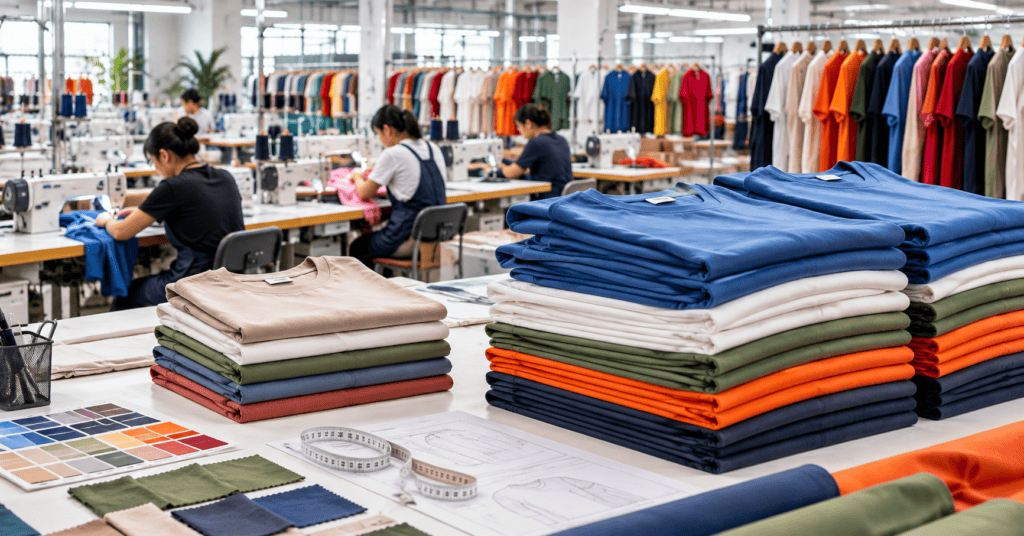
When a clothing brand contacts a manufacturer, one of the first questions is usually about clothing manufacturing MOQ, or the minimum order quantity required to begin production. The answer might be 50, 100, or 300 pieces, but that number alone rarely explains the full production requirements. A minimum can apply to an entire order, an individual style, a specific color, or even a custom component, which means brands need to understand exactly what is included before comparing manufacturing quotes.
A manufacturer may be willing to produce 100 garments, while the fabric mill, zipper supplier, or custom label manufacturer has a different minimum requirement. These differences can affect material availability, customization options, production costs, and the amount of inventory a brand must commit to before launching a product.
Understanding MOQ is therefore about more than finding a manufacturer willing to accept a small order. It means identifying which minimums apply to each part of the project, what determines those quantities, and how the production plan can be adjusted to balance cost, flexibility, and inventory risk.
What Does MOQ Mean in Clothing Manufacturing?
Clothing manufacturing MOQ can vary within the same project because different materials, production methods, and customization requirements may have their own minimum quantities. Understanding these differences helps brands evaluate whether a proposed order is practical before committing to production.
For example, a manufacturer might quote a minimum of 100 pieces per style while requiring a separate minimum for each color. Custom-dyed fabric, branded labels, specialized trims, printing, and embroidery may also have their own requirements. These additional minimums can increase the total order commitment, even when the planned garment quantity is relatively small.
Instead of asking only, “What is your MOQ?”, brands should ask what minimum quantities apply to each part of their product and order. This provides a clearer picture of the actual production commitment and helps prevent unexpected costs later in development.
Why Do Clothing Manufacturers Have MOQs?
Minimum order quantities are not simply arbitrary numbers used to discourage small brands. Apparel manufacturing involves preparation, coordination, and production costs that exist whether a factory produces 30 garments or 3,000. Pattern preparation, production planning, machine setup, fabric ordering, cutting, decoration setup, and quality-control procedures all require resources before the finished products are ready.
Depending on the product, these activities may include:
- Pattern preparation and production planning
- Machine setup and cutting preparation
- Fabric sourcing and ordering
- Thread, trim, and component preparation
- Printing or embroidery setup
- Custom labels and packaging
- Quality-control procedures
Suppliers further upstream can impose their own minimums as well. Fabric mills, dye houses, zipper manufacturers, label producers, and packaging suppliers may require certain quantities before accepting custom orders. As a result, a garment factory’s MOQ may be influenced by requirements originating elsewhere in the supply chain rather than by sewing capacity alone.
MOQ per Order, Style, Color, and Fabric: What’s the Difference?
One of the most important details to clarify before comparing manufacturing quotes is what the stated minimum actually applies to. A manufacturer advertising an MOQ of 100 pieces may be describing several different production arrangements, each with different implications for the brand.
MOQ per Order
An MOQ per order means the manufacturer requires a minimum total quantity across the order. Under agreed conditions, the brand may be able to distribute that quantity among different products, colors, or sizes. However, this flexibility should never be assumed without confirmation because individual materials or styles may still have separate restrictions.
MOQ per Style
An MOQ per style applies independently to each garment design. If a brand wants to manufacture three different styles and the minimum is 100 pieces per style, the total order would need to include at least 300 garments. This can significantly change the initial investment required for a collection with multiple designs.
MOQ per Color
A manufacturer may accept a particular style at a relatively low total quantity but require a minimum number of units in each color. For example, introducing several colorways could increase the total order even when the underlying garment design remains unchanged. Brands planning broad color assortments should clarify these requirements before finalizing their collection.
MOQ per Fabric
Fabric requirements depend on availability and customization. When several products use an existing stock fabric, sourcing may be relatively straightforward. If the brand requires a particular composition, weight, finish, or custom color, the fabric supplier may impose a separate minimum that exceeds the material needed for the planned garment quantity.
MOQ for Customization
Custom labels, zippers, buttons, metal hardware, hangtags, embroidery, printing, and branded packaging may each involve separate suppliers or setup requirements. These minimums can affect the economics of the entire project, especially when a small garment order requires purchasing more components than will actually be used.
An MOQ of 100 pieces per order is not the same commercial proposition as 100 pieces per style or 100 pieces per color. Understanding this distinction is essential before evaluating a manufacturer’s pricing.
What Determines the MOQ for a Clothing Order?
Clothing manufacturing MOQ is not a universal number, even when different products are ordered from the same manufacturer. Fabric availability, garment construction, decoration methods, and customization requirements can all influence the minimum quantity that makes production practical.
Fabric Availability and Color
Using an existing stock fabric may make smaller production runs possible because the supplier does not need to manufacture material specifically for the order. Custom fabrics, specialized compositions, unusual weights, and particular finishes can require larger commitments from the mill. The same distinction applies to color: stock colors may be available in smaller quantities, while custom dyeing can introduce a separate minimum for each shade.
Garment Construction and Production Method
A basic T-shirt and a technical jacket require different materials, components, machinery, and production preparation. More complex construction can affect how efficiently a factory organizes production and what quantity makes commercial sense. The production method also matters because decorating existing blank garments is fundamentally different from developing an original cut-and-sew product. A supplier offering very low minimums for one model may require substantially higher quantities for another.
Printing, Decoration, and Branding
Screen printing, sublimation, embroidery, all-over printing, patches, and appliqués have different setup requirements. Branded zippers, buttons, drawcords, metal hardware, labels, hangtags, and packaging may also come from separate suppliers. Even when the garment itself can be produced in a small quantity, these components may affect the total order cost or require additional purchases.
Understanding these factors helps brands distinguish between a manufacturer’s general MOQ and the minimum quantity that is realistic for their specific product.
Why Fabric MOQ Can Be Different From Garment MOQ
Fabric MOQ is particularly important for brands developing custom clothing. A factory may agree to sew 100 garments, but that does not necessarily mean a fabric supplier will manufacture exactly the amount of custom material required for those garments.
Fabric suppliers may establish minimums based on knitting or weaving, composition, width, dyeing, printing, finishing, and other production requirements. If the amount of fabric that must be purchased exceeds what the garment order will consume, the brand and manufacturer need to decide how the excess material will be handled.
Depending on the project, possible solutions include choosing an available fabric, selecting a stock color, increasing the garment quantity, or using fabric sourcing support to identify suitable alternatives. The appropriate decision depends on product requirements, budget, expected demand, and future production plans.
The important point is to identify any mismatch between fabric and garment minimums before production is approved. Otherwise, a brand may discover that its planned order requires substantially more material investment than expected.
How Custom Colors, Trims, and Packaging Affect MOQ
In private label clothing manufacturing, the garment itself is only one part of the order, particularly when branded labels, custom trims, and packaging are involved. Consider a small brand planning to produce 100 hoodies with a custom fabric color, branded zipper pulls, woven neck labels, size labels, custom drawcords, embroidered logos, and printed polybags. Even if the sewing factory accepts the order, not every component supplier may be willing to produce exactly 100 units.
A low garment MOQ can therefore become less attractive when the brand must purchase larger quantities of unused trims, packaging, or other custom materials. Those additional purchases may increase the initial investment and create leftover inventory that has no immediate use.
Before approving customization, brands should distinguish between the number of finished garments they need and the quantity of materials or components they must purchase to produce them. Asking whether quoted minimums include all requested customization can prevent misunderstandings and make manufacturing proposals easier to compare.
How Low MOQ Affects Cost per Unit
A lower clothing manufacturing MOQ can reduce the amount of money tied up in inventory, but it does not necessarily result in the lowest cost per garment. Many manufacturing expenses are spread across the number of units produced, including development, sourcing, production preparation, cutting setup, and certain decoration processes.
When these costs are distributed across 50 garments instead of 500, the cost per unit can increase. A smaller order may therefore reduce the initial inventory commitment while creating a higher production cost for each garment.
For a new clothing brand, that trade-off can still make commercial sense. Producing a smaller quantity may allow the business to test customer demand, evaluate product performance, and avoid committing too much capital to unproven inventory. The right decision depends on the expected selling price, available working capital, product requirements, and the brand’s confidence in future demand.
Low MOQ and Low Total Cost Are Not the Same Thing
It is easy to assume that the manufacturer offering the lowest MOQ represents the least expensive or lowest-risk option. In practice, the smallest minimum does not always produce the most favorable overall project cost.
Consider two hypothetical offers. Manufacturer A accepts 50 pieces but charges a higher unit price and requires separate purchases of custom trims. Manufacturer B requires 150 pieces, offers a lower unit price, and can use components already available within its supply chain. The first option involves fewer finished garments, but it may not be the less expensive arrangement once all development, material, and customization costs are included.
A meaningful comparison should account for the complete production commitment, including:
- Product development and sampling
- Fabric and trims
- Garment manufacturing
- Printing or embroidery
- Labels and packaging
- Inspection and quality control
- Freight and applicable duties
- Excess materials or components
MOQ is one part of this calculation, not the calculation itself. Brands should compare the total investment, the expected cost per unit, and the inventory risk associated with each proposal before choosing a manufacturer.
When Does Low MOQ Make Sense?
A smaller initial production run can be particularly useful when a brand is entering a market, introducing a new product, or testing an unfamiliar category. At these stages, uncertainty about customer demand can make a large inventory commitment difficult to justify.
For example, a brand may use low MOQ production to:
- Test a new product before expanding the collection
- Launch its first clothing line
- Evaluate customer response to a new color
- Test fit and sizing with real customers
- Introduce seasonal or limited-edition products
- Enter a new market
- Reduce exposure to excess inventory
These advantages help explain why low MOQ manufacturing can appeal to startups and emerging clothing brands. Smaller production runs allow businesses to gather information about demand while limiting the amount of capital committed to finished inventory.
However, low MOQ should be treated as a production strategy rather than an automatic goal. The smallest possible order is not necessarily the most efficient or profitable option, especially when the product involves substantial customization.
When a Very Low MOQ May Not Be the Best Option
Very small orders can become difficult when a product requires specially developed fabric, custom dyeing, complex printing, branded hardware, multiple colorways, extensive size ranges, specialized construction, or highly customized packaging. These requirements may create minimum quantities that cannot be reduced simply by ordering fewer finished garments.
There is also a commercial consideration. If a very small production run increases the unit cost beyond what the brand’s intended retail price can support, reducing inventory risk may create a profitability problem instead. A lower initial quantity may preserve capital, but the resulting margin still needs to make sense for the business.
Rather than asking only for the lowest available MOQ, brands should determine what production quantity fits their product requirements, pricing strategy, available capital, and current stage of growth.
Sampling Is Not the Same as Low-MOQ Production
A manufacturer agreeing to make one or several samples does not necessarily mean the same materials and production processes can be used economically for a very small bulk order. Sampling and bulk manufacturing serve different purposes and may involve different purchasing arrangements.
In custom clothing manufacturing, samples are essential development tools that allow brands to evaluate fit, measurements, fabric, construction, color, decoration, labels, trims, and overall product appearance. They help identify changes before the brand commits to manufacturing a larger quantity.
Bulk production, however, introduces additional material purchasing, production planning, and supplier requirements. Before approving a sample, brands should understand whether the selected fabrics and components will remain available at the intended production quantity. This helps prevent a situation in which an approved design must later be modified because a particular material or component cannot be sourced at the planned MOQ.
Why Two Manufacturers Can Quote Different MOQs for the Same Garment
When choosing a clothing manufacturer, a brand may discover that two suppliers quote very different minimum order quantities for the same product specification. That does not automatically mean one manufacturer is more suitable for startups or more flexible than the other. The difference may reflect how each company organizes sourcing and production.
Manufacturers can have different fabric supplier networks, stock material availability, equipment, factory capacity, subcontractors, trim suppliers, printing capabilities, and relationships with material mills. One may already have access to the required fabric, while another needs it manufactured specifically for the project. Similarly, one supplier may use stock components while another relies on custom production.
Production specialization also matters. Some manufacturers are organized around small-batch development, while others are optimized for higher-volume manufacturing. Their minimum quantities may reflect these operating models rather than a simple willingness or unwillingness to work with smaller brands.
For this reason, MOQ should always be evaluated alongside what the manufacturer is actually offering, including materials, customization, production methods, and the scope of services included in the quote.
Questions to Ask a Low MOQ Clothing Manufacturer
Before comparing quotes, brands should make sure they are evaluating the same production requirements. A clearly stated MOQ is useful, but it should be accompanied by information about how quantities are calculated and what additional minimums may apply.
| If the manufacturer says… | The brand should ask… |
| “Our MOQ is 100 pieces.” | Is that per order, style, color, or design? |
| “You can mix sizes.” | Can all sizes be included within the same MOQ? |
| “Multiple colors are available.” | Is there a minimum for each color? |
| “We offer custom fabrics.” | Does the fabric supplier have a separate MOQ? |
| “Custom colors are available.” | Is there a dyeing minimum? |
| “We can make custom trims.” | What minimums apply to labels, zippers, buttons, or hardware? |
| “Custom packaging is available.” | Is packaging subject to a separate minimum? |
| “We offer low MOQ production.” | Which products and materials qualify? |
| “The sample is approved.” | Will the same materials and components be available for bulk production? |
| “The unit price is X.” | What is included in that price, and what is charged separately? |
The objective is not simply to negotiate the smallest possible number. It is to understand the real production commitment behind that number, so the brand can compare options accurately and avoid unexpected costs.
Choosing the Right MOQ for Your Clothing Brand
Choosing the right clothing manufacturing MOQ requires evaluating the entire production plan, including material availability, customization requirements, unit costs, and future production needs. A lower MOQ can help a clothing brand test demand, preserve working capital, and reduce exposure to excess inventory, but these advantages must be balanced against the overall economics of production.
Before choosing a manufacturer because it advertises a particularly low minimum, brands should understand exactly what that minimum includes. The same stated quantity can represent very different production arrangements depending on whether it applies to the entire order, each style, each color, or individual materials and components.
For fashion brands developing custom apparel, Fashion Atlas Group can help coordinate product development, material sourcing, sampling, manufacturing, quality control, and logistics around the requirements of each project. Understanding those requirements early makes it easier to develop a production plan that balances product specifications, budget, and realistic order quantities.