
Introduction
Military and tactical garments can look straightforward on a sketch. Once development begins, however, small construction decisions start to matter much more than they would in ordinary apparel.
A pocket is no longer just a pocket if it has to remain accessible while the wearer is moving, kneeling or carrying equipment. Reinforcement only helps when it is placed where the garment actually takes stress. Fabric choice affects more than appearance as well; abrasion resistance, tear behavior, breathability, weight and long-term wear can all influence whether the finished product works as intended.
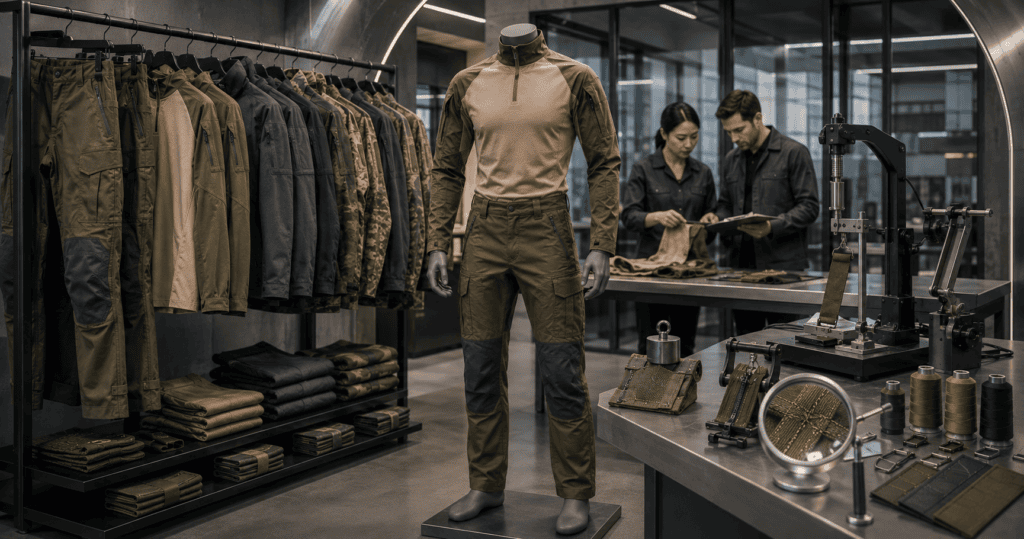
In one military apparel project at Fashion Atlas Group, a custom military uniform manufacturer, the development process included tactical pants and a combat shirt with different functional requirements. The team reviewed seam strength, pocket reinforcement, zipper durability, panel integration, mobility and structural stability under load before the garments were approved for production. None of those decisions could be made from the camouflage design alone.
The buyer first needs to define how the garment will be used, what parts of the product carry the most stress, which materials and construction details are required, and what has to be tested before bulk production begins. Those decisions affect everything that follows, from pattern development and sampling to quality control and final approval.
I think the most useful way to approach custom military uniform manufacturing is to start with function and work backward into construction. Once the use conditions are understood, the development conversation becomes much more specific.
Military Uniform Manufacturing Starts With Use, Not Appearance
A military garment should be developed around what the wearer needs to do in it, not around how the finished uniform looks in a product photo.
That sounds obvious, but it changes a surprising number of production decisions. A pair of tactical pants worn for long periods in the field may call for different pocket placement, reinforcement and fabric performance than a uniform intended mainly for training or controlled environments. The same applies to combat shirts, jackets and other pieces that have to work with equipment, layers or protective gear.
Before development begins, I would want to understand the conditions the garment is expected to face. Will the wearer spend much of the day walking, kneeling or climbing? Which areas are likely to rub against equipment? Does the garment need to be worn over another layer? Are pockets expected to carry weight, and do they still need to be reachable when the wearer changes position?
Answers to those questions begin to shape the product. Extra reinforcement may make sense at one stress point and create unnecessary stiffness somewhere else. A larger pocket may carry more equipment but become uncomfortable when it is full. Adding stretch can improve mobility, while the wrong placement or fabric combination can change the way the garment hangs and moves.
This is why a specification built mainly around color, camouflage pattern and a list of visible features is rarely enough for custom military uniform manufacturing. The factory also needs to understand how those features are expected to work in use.
For me, the better starting point is understanding what the wearer will be doing in the garment. Once the expected movement, load, climate and working conditions are clear, it becomes much easier to make decisions about construction and testing.
Fabric Has to Match the Conditions
Fabric selection for military and tactical garments should start with the conditions in which the garment will actually be used. A material that performs well in one environment may be the wrong choice in another, even if both are described as durable.
One useful distinction is between fiber composition and fabric construction. Ripstop and twill describe the weave structure, while terms such as NyCo describe the fiber blend. That matters because durability, comfort and resistance to tearing depend on more than one variable. A nylon-cotton blend woven as ripstop, for example, behaves differently from a heavier twill made from another composition.
The properties that matter most will also depend on how the garment is used. Abrasion resistance becomes important in areas that repeatedly rub against equipment, while tear resistance matters more where the fabric is likely to snag or take sudden stress. In warmer conditions or during long periods of movement, breathability, drying time and fabric weight may become just as important.
Water repellency is another area where specifications need to be precise. A water-repellent finish can help the surface shed light moisture, but that does not make a woven garment waterproof. If the garment needs to withstand sustained rain or water pressure, a different fabric construction or protective layer may be required.
In practice, one fabric does not always need to solve every problem. A military garment can combine a more durable material in high-wear areas with lighter or more flexible panels where mobility and ventilation matter more. Each material should have a clear reason for being there and a specific job to do.
I would also avoid choosing fabric simply because it is described as “military grade.” What matters more is how it is expected to perform under abrasion, repeated washing, heat, moisture and movement — and which of those demands actually matter for this garment.
Construction Matters Where the Garment Takes Stress
Adding more stitching everywhere does not automatically make a garment more durable. Reinforcement works best when it is placed where the garment takes repeated load, friction or pulling force.
On tactical pants, those areas may include pocket attachment points, seat and knee zones, belt loops, waistband sections or other places that repeatedly take stress from movement or contact with equipment. In a combat shirt, the demands can be different. Sleeves, collar construction and transitions between body fabric and reinforced panels may need more attention than areas that remain under relatively little stress.
The same principle applies to seams. A stronger-looking seam is not automatically the right choice for every fabric or every part of the garment. Seam performance depends on the fabric, thread, stitch type and the way the seam is assembled. ASTM D1683, for example, is used to evaluate sewn seam strength and seam slippage in woven apparel fabrics, but the standard also notes that laboratory seam testing does not by itself predict how a garment will perform during actual wear.
Reinforcement therefore needs to be considered as part of the overall construction rather than as a visual feature. Extra rows of stitching or heavier material can improve durability in the right place, but they can also add stiffness, bulk or unnecessary weight if they are used without a clear reason.
In the Fashion Atlas Group military apparel project, stress points were reinforced with bar tacks and double stitching, while seam strength and structural integrity under load were reviewed during development. What mattered was not simply adding reinforcement. It was identifying where the garment needed it and then checking whether the construction held up under the expected stress.
The tech pack should therefore go beyond marking certain areas as “reinforced.” It should define where reinforcement is required, what construction is expected and, when performance is critical, how that construction will be evaluated before bulk production begins.
Pocket Design Is a Functional Decision
On military and tactical garments, pockets affect much more than storage capacity. Their position, depth, construction and closure can change how the garment behaves when the wearer moves or carries equipment.
A cargo pocket may look perfectly proportioned when it is empty and the wearer is standing still. Once it is loaded, however, the weight can pull on the surrounding fabric, shift the way the pants sit on the body or create bulk in a place that becomes uncomfortable when kneeling, sitting or moving quickly.
Accessibility matters just as much. A pocket that is easy to reach while standing may become awkward when the wearer is crouched, prone or working around other equipment. For that reason, placement should be tested together with fit and movement rather than decided only from a flat sketch.
The construction around the pocket also deserves attention. Attachment points and corners often take more stress than the center of the pocket itself, especially when heavier items are carried. Reinforcement in those areas can help distribute load and reduce the chance of tearing or seam failure.
Closure choice introduces another set of trade-offs. Zippers, hook-and-loop systems and buttons differ in speed of access, security, repairability and how well they hold up to dirt and repeated use. No single closure is automatically best for every military garment. The right choice depends on what the pocket will hold and how the wearer needs to access it.
Testing with an empty sample is not enough in this case. Loading the pockets and reviewing the garment during movement can reveal problems that are difficult to see otherwise: pulling at the waistband, restricted motion, awkward access or a pocket that shifts out of position under weight.
For me, that is the point where pocket design stops being a styling decision and becomes part of how the garment actually has to work.
Mobility Changes the Pattern and Panel Design
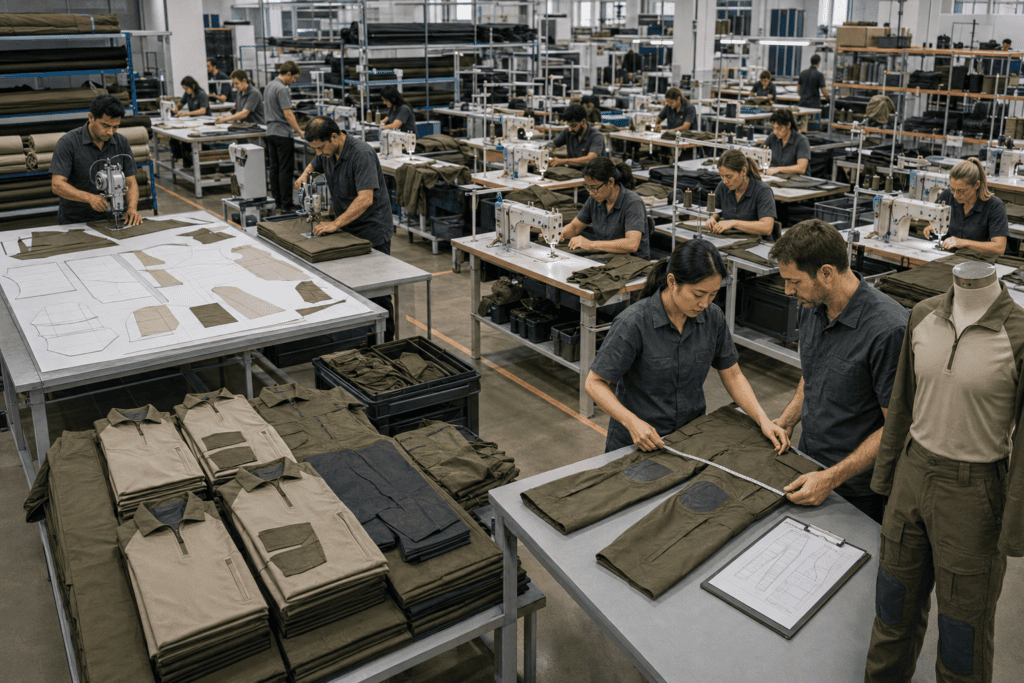
A military garment has to work while the wearer is moving, not just when standing in a fitting room.
That changes how fit should be evaluated. Tactical pants may need enough room through the hips and knees for crouching, climbing or kneeling, while a combat shirt has to allow the shoulders and arms to move without pulling the body of the garment out of position. Depending on the design, articulated shaping, gussets, stretch panels or different fabric zones can help provide that range of motion.
More mobility is not always better, though. Adding too much volume can make a garment feel loose or interfere with equipment, while excessive stretch may change how pockets, reinforcement or protective elements stay in place. The pattern has to balance movement with stability.
Panel placement matters for the same reason. A lighter or more flexible fabric can improve comfort in one area, but the transition between materials still has to lie smoothly and hold up under repeated movement. Poorly integrated panels can create bulk, pulling or weak points even when each fabric works well on its own.
A combat shirt, for example, may combine a breathable body fabric with reinforced sleeves, but the development review still needs to include panel integration and mobility rather than judging the garment only by fit measurements or appearance.
Testing should include the positions and movements the garment is actually expected to accommodate. A sample that feels comfortable while standing may behave very differently when the wearer reaches, bends, kneels or works with loaded pockets and equipment.
Fit approval should go beyond deciding whether the garment simply “fits.” A successful fit also allows the wearer to move without compromising the stability, access and durability the product was designed to provide.
Hardware and Closures Need Their Own Testing
Small components can cause serious problems in a military garment. A zipper that begins to stick, a snap that pulls away from the fabric or a closure that opens under movement can affect the usefulness of an otherwise well-constructed product.
Choosing hardware therefore involves more than selecting a size, finish or brand. The buyer should consider how often the component will be opened and closed, and how dirt or repeated use may affect its performance.
Different closure systems come with different trade-offs. Hook-and-loop can offer fast access but may collect debris over time. Buttons can be relatively simple to replace but may take longer to operate. Zippers can provide a secure, low-profile closure, although repair becomes more difficult if the zipper itself fails. The choice should depend on how the garment will actually be used, not on the assumption that one closure is inherently more “tactical” than another.
Placement matters too. Hardware attached to a high-stress area needs enough support from the surrounding fabric and construction. A durable zipper does not solve much if the seam or material around it begins to fail first.
Zipper durability is worth reviewing during development because hardware may work well on a new sample and still behave differently after repeated opening, loading and movement.
Critical closures are worth identifying before sampling starts, along with the way each one should be evaluated. The goal is not to test every component in isolation, but to understand whether the hardware, fabric and construction work together under the conditions the garment is expected to face.
The Sample Has to Be Tested, Not Just Approved Visually
In custom military uniform manufacturing, a garment can look correct on a fitting sample and still reveal weaknesses once the wearer starts moving, loading the pockets or using it repeatedly.
Visual approval is only one part of the process. Fit, proportions, camouflage placement and overall appearance matter, but functional garments also need to be checked under the kinds of stress they are expected to face. A seam may look clean and still begin to slip under tension. A loaded pocket can pull differently on the garment than an empty one, while a zipper that works smoothly during a fitting may behave differently after repeated use.
Laboratory testing can help answer some of those questions. ASTM D1683, for example, is used to evaluate sewn seam strength and seam slippage in woven apparel fabrics. The standard also notes that seam testing does not predict actual wear performance on its own. A technically strong seam still has to work as part of a complete garment.
Movement testing can reveal a different set of problems. Wearing the sample while bending, kneeling, reaching or moving with loaded pockets can expose pulling, restricted mobility, pressure points or construction details that seemed perfectly acceptable when the garment was standing still.
Reinforcement and hardware need the same kind of practical review. Areas designed to carry weight should be reviewed under load, while closures that will be used frequently should be opened and closed enough times to reveal obvious weaknesses before production begins.
Sample approval therefore needs to answer more than “Does this look right?” The garment also has to behave as intended when the features that matter most are actually being used.
Fit for Tactical Clothing Is Different From Ordinary Apparel Fit
Fit in military and tactical clothing is not only about whether the garment looks proportionate on the body. It also has to account for movement, equipment and the conditions in which the garment will actually be worn.
A pair of tactical pants may need enough room through the hips and knees for crouching, climbing and kneeling without pulling at the waistband or restricting movement. Combat shirts need to be evaluated differently. Shoulder mobility, sleeve movement, collar structure and the way the body fabric behaves under armor or other layers can all affect comfort and function.
Layering can change the fit as well. A garment developed to fit correctly over a base layer may feel too tight once additional equipment or insulation is added. Extra volume, however, is not automatically a solution. Too much ease can cause fabric to bunch, shift pockets out of position or interfere with gear.
For this reason, fit testing should reflect the situations the garment is being designed for rather than relying only on static measurements. Fit testing should also account for the layers and equipment the garment will be worn with. A size that works over a base layer may need different ease once armor, insulation or other equipment is introduced.
Measurements still matter, but they are only part of the approval. A military garment can match the size chart and still feel wrong once movement, load and layering are introduced.
What matters is whether the fit still works once the wearer starts moving, carrying equipment and using the garment as intended.
Bulk Production Has to Reproduce the Approved Construction
Once custom military uniform manufacturing moves from development into bulk production, the challenge changes. The focus shifts from deciding what the product should be to reproducing the approved construction consistently across the full order.
Small changes can easily appear during bulk manufacturing. A cargo pocket can sit higher or lower than intended, reinforcement can end too early, panel alignment can drift, or a closure can be attached differently from the approved sample. None of those changes may look dramatic on a single garment, but across a full production run they can affect fit, access and durability.
The approved sample should be backed up by clear specifications. Pocket dimensions and placement, reinforcement zones, seam construction, panel boundaries, hardware, labels and other critical details need to be defined well enough that the factory is not relying on memory or interpretation.
Size grading needs attention too. A pocket that sits correctly on a medium size may need careful grading so that it remains accessible and balanced on smaller or larger garments. Functional elements should not simply be scaled mechanically if doing so changes how the product works.
Color and material consistency can matter too, especially when several fabrics or reinforced panels are combined in the same garment. Shade variation between components may be visually obvious, while differences in stretch, weight or hand feel can affect how the finished piece moves.
For the buyer, bulk approval should not mean assuming that every unit will automatically match the development sample. Critical details need to be identified in advance and checked as production moves forward.
Quality Control Should Reflect the Product’s Function
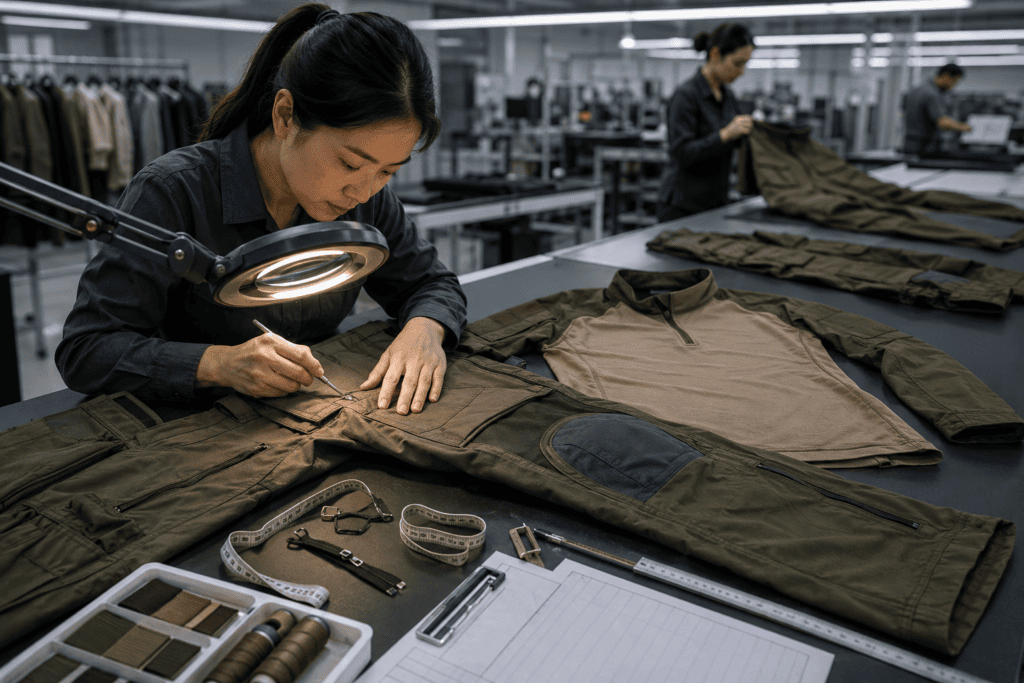
Quality control for military and tactical apparel should be built around the parts of the garment that matter most in use, not just around general workmanship.
Measurements, stitching, color, labels and packaging still need to be checked, but functional details deserve their own attention. Pocket placement affects access, reinforcement has to stay in the correct stress zones, and closures need to work reliably. Panel construction should also remain consistent with the approved sample.
Some problems are easier to catch while production is still underway. If a pocket begins shifting out of position or sewing teams start handling the same seam differently, correcting the problem early is much easier than finding it across a finished batch.
Final inspection then confirms whether the completed garments still match the approved standard. Depending on the product, that may include checking measurements, workmanship, reinforcement placement, hardware, pocket dimensions, panel alignment and overall consistency across sizes and colors.
QC should follow the product’s real function. A cosmetic defect and a construction problem at a high-stress area do not carry the same risk, even if both are technically “defects.”
Having a quality control process is not enough on its own. What matters is whether that process is checking the features that can actually affect performance in use.
Define Compliance Before Development Starts
Military apparel can be produced for very different buyers, and the word military by itself does not define a single technical standard.
A commercial tactical brand, a private security organization and a government procurement program may all order garments that look similar but follow very different requirements. Fabric composition, camouflage pattern, labeling, testing, flame resistance, color performance or even specific construction details may be defined by the buyer, a contract or an external specification.
Compliance therefore needs to be clarified before development begins. An older reference garment or a previous specification can be useful, but it should not automatically be treated as the current standard. Military uniform requirements can change over time, and different garments within the same program may also follow different technical documents.
For the manufacturer, those requirements affect much more than paperwork. A required fabric specification can narrow sourcing options. Testing requirements may influence material selection and development time, while a prescribed construction detail can change the pattern or sewing process. If those requirements appear only after sampling has started, revisions can become expensive very quickly.
Certifications need the same level of scrutiny. A certification logo or a statement that a fabric is “military grade” does not explain what requirement the product actually meets. What matters is which specification, test method or certification actually applies to the order, and whether the material or facility can be verified against it.
Buyers should also distinguish between two very different situations. If the garment is being developed for a specific defense, government or institutional contract, the applicable specifications should be identified before the first sample. If it is commercial tactical apparel, the performance requirements still need to be defined, but they should not be presented as official military standards unless they genuinely are.
MOQ, Materials and Specialized Components
MOQ in custom military uniform manufacturing is not always determined by the garment alone. Specialized fabrics, custom colors, hardware, trims and finishing processes may each come with their own minimum order requirements before sewing even begins.
A buyer may be comfortable with the factory’s minimum order for finished garments and still discover that the selected fabric requires a larger production run. Custom dyeing may require a separate minimum, while specialized zippers, webbing, hook-and-loop systems or reinforcement materials may only be available in certain quantities.
Multiple materials can make the MOQ picture more complicated. A combat shirt, for example, may use one fabric for the body and another for reinforced sleeves or panels. Tactical pants can involve a base fabric, reinforcement material, stretch components and multiple types of hardware. Each of those inputs can affect how practical a small production run really is.
I would separate the garment MOQ from the material and component minimums during development. A low MOQ clothing manufacturer may be willing to sew a relatively small quantity, but that does not necessarily mean every required input can be sourced economically at the same volume.
It also helps to understand what happens to excess material. Can it be used for a repeat order? Does the buyer need to purchase the full fabric minimum? Will custom-colored trims have to be reordered from scratch later? Those details can change the real cost of a low-volume program.
A realistic production plan needs to account for MOQ across the whole product, not just the number of finished uniforms. This matters most when specialized materials or custom components are essential to the garment rather than optional details.
Questions to Resolve Before Sampling Begins
A good sampling process starts before the first pattern is made. The more important decisions that remain open at that point, the more likely the sample is to become a round of guessing rather than a useful production test.
Start with the intended use. The manufacturer should know where and how the garment will be worn, how much movement it needs to accommodate, whether it will be used with equipment or additional layers, and which areas are expected to take the most stress.
Material requirements should also be settled as early as possible. In custom clothing manufacturing, fabric, trims, construction and fit often need to be coordinated before sampling begins. Fabric composition, weave, weight, stretch, reinforcement materials, finishes and any fixed color or camouflage requirements should already be clear. If a specific test method or performance requirement applies, it needs to be identified before the wrong material reaches the sampling stage.
Vague construction instructions can create unnecessary revisions. Pocket placement, pocket capacity, closures, reinforcement zones, seam types, panel transitions and hardware should be described clearly enough that the first sample reflects the intended product rather than the factory’s interpretation of it.
Fit needs its own set of answers. Who is the garment being sized for? What base measurements or size chart will be used? Does the pattern need to allow for armor, thermal layers or other equipment? Which movements should be checked during fitting?
It is also worth deciding what will count as approval. A sample can be visually correct and still need changes after movement, load or seam testing. Buyers should know which features have to be reviewed functionally and which details must match the specification before the garment can move into bulk production.
Resolving these questions early does not eliminate sampling revisions. It does, however, make each round more useful because the team is refining a product that has already been clearly defined.
Conclusion
Custom military uniform manufacturing becomes much easier to manage when the product is defined around actual use rather than appearance alone. Decisions about fabric, fit, reinforcement, pockets, closures and testing should all come back to the conditions the garment is expected to face.
The development process becomes much more predictable when those requirements are clear before sampling begins. The manufacturer has a defined target, and the buyer has something concrete against which to review samples, production and quality.
Not every tactical garment needs the same construction, materials or testing. What matters is that those choices are intentional and can be checked against the requirements agreed at the start.
For buyers, visual approval is only part of the decision. The stronger basis for moving into production is knowing that the garment has been developed and tested around the way it is expected to perform.