

Introduction
For US apparel brands, the decision to manufacture domestically or overseas is often framed as a choice between speed and cost. In practice, that comparison is too simple.
At Fashion Atlas Group, we see this decision come up often when brands compare domestic and overseas production options. The challenge is that the lowest quote or the closest factory is not always the best fit for the product.
Proximity can make sampling, communication and production oversight easier, while an overseas supplier may offer deeper specialization, stronger access to certain fabrics and trims, or a cost structure that works better at scale. Neither advantage exists in isolation, and neither automatically makes one option better than the other.
The real difference often appears in the parts of the process that are less visible in a factory quote: development time, revision cycles, production capacity, duties, freight, inventory exposure and the ability to reorder when demand changes.
For that reason, I think brands weighing domestic vs overseas clothing manufacturing should start with something more useful than asking which option is better. The real question is which production setup gives a particular product the right balance of cost, capability, speed and risk.
What Domestic Clothing Manufacturing Can Change for a US Brand
Domestic production is often described as the faster option, but proximity by itself is not what makes the difference. What matters more is how much time can be removed from the back-and-forth that happens before and during production.
When a product is still being developed, small decisions can create surprisingly long delays. A fit sample may need another round. A construction detail may need to be adjusted. The fabric may behave differently than expected once the garment is sewn. If the factory is nearby, samples can move between the brand and the production team more quickly, and in some cases the brand can review problems in person rather than trying to resolve everything through photographs, emails or international shipments.
That advantage becomes more important when a style is new or technically demanding. The sewing time itself may not be dramatically different, but the intervals between one decision and the next can be. Sampling, fit corrections and approvals all add to the real production calendar, and those stages are easy to underestimate when a brand looks only at the quoted production lead time.
Being closer can also make production oversight more practical. A US brand may be able to visit the factory, review a sample before approving the next stage, or deal with a construction issue without waiting for an international shipment. That does not guarantee better quality, but it can make communication more immediate when something needs attention.
For me, this is where the strongest case for domestic manufacturing often appears. It is not simply that the factory is located in the United States. It is that a shorter feedback loop can reduce friction while the product is still changing.
The value of that speed, however, depends heavily on the product. A stable repeat style that has already been produced several times may gain relatively little from having the factory nearby. A new silhouette going through multiple fit and construction revisions can be a very different case.
Where Domestic Production Can Become Restrictive
The advantages of proximity become less persuasive when the factory cannot support what the product actually needs. A manufacturer may be easy to visit and quick to respond, yet still be the wrong production partner because of capacity, equipment, material access or category experience.
Cost is usually the most visible limitation. Higher domestic labor and operating expenses can push the unit price above what a brand’s retail model can comfortably absorb. That does not automatically make domestic production uneconomic, but it does mean the comparison has to extend beyond the appeal of a shorter supply chain.
Capacity can be just as important. A smaller factory may work well during development or an early production run but become difficult to scale with once order volume increases. The opposite problem can also occur: a facility may have enough total capacity, but not for the particular construction method, machinery or finishing process the product requires.
Material sourcing adds another layer. Some fabrics, trims and technical components are easier to source inside established overseas manufacturing clusters than through a domestic supply chain. A factory may be fully capable of sewing the garment while still depending on imported fabric or components, which reduces some of the speed advantage that initially made local production attractive.
This is why I would not treat “Made in the USA” and “more flexible” as interchangeable ideas. Real flexibility depends on more than where the sewing happens. It also depends on materials, suppliers, capacity and how quickly the factory can respond when something changes.
For some products, domestic manufacturing gives a brand exactly the control and responsiveness it needs. In other cases, geography is not the real limitation. What matters more is whether the factory has the right capabilities, supplier network and capacity to grow with the product.
Overseas Manufacturing Is More Than a Lower Labor Cost
Overseas manufacturing is often reduced to one argument: lower labor costs. That matters, of course, but it does not explain why US brands source so many different types of apparel internationally.
Different sourcing countries have developed different strengths. Some are built around large-volume basics, while others are known for denim, technical apparel, detailed finishing or more vertically integrated textile supply chains. The U.S. International Trade Commission has highlighted these differences across major apparel suppliers, showing that competitiveness can come from specialization, access to materials, vertical integration and production capability as much as from labor cost.
That distinction matters when a brand is choosing where to produce. A factory in one country may be excellent at high-volume jersey basics but poorly suited to a tailored outerwear program. Another region may have stronger access to performance fabrics, washing facilities, embroidery, specialty trims or the machinery required for a more complex garment.
In that sense, “overseas” is not really one manufacturing model. Bangladesh, India, Indonesia, Pakistan, Vietnam and China all sit inside very different production ecosystems, with different strengths, supplier networks and cost structures.
A lower quote may be attractive, but the more useful question is whether the surrounding supply chain already knows how to make the product well. When the right materials, machinery and production experience are concentrated in one region, that expertise can matter more than the number of miles between the factory and the brand.
Product Complexity Can Matter More Than Geography
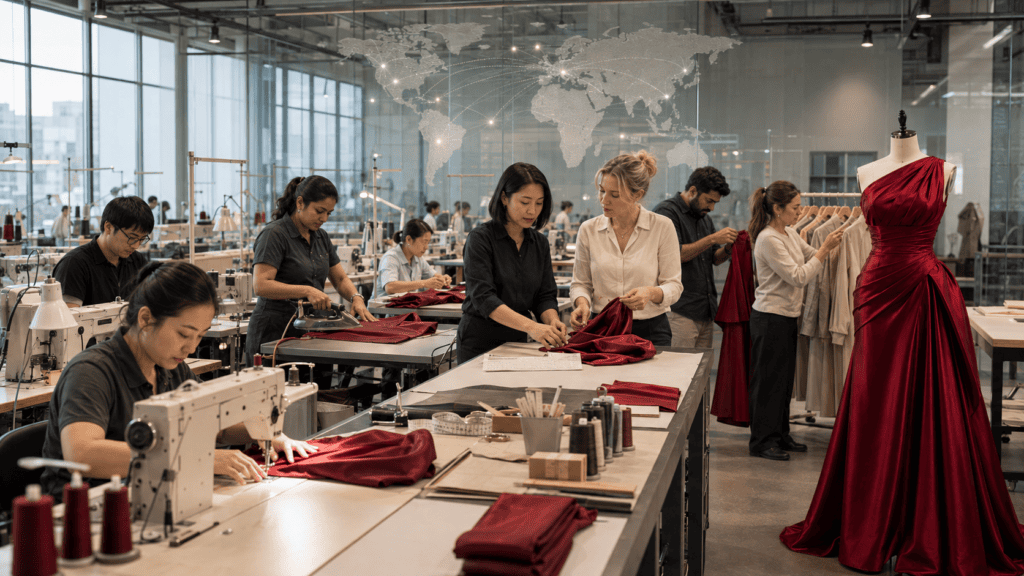
A product does not become easier to manufacture simply because the factory is closer to the customer. In many cases, the more important question is whether the surrounding production ecosystem is built for that type of garment.
Basic styles and technically complex products place very different demands on custom clothing manufacturing. A straightforward jersey T-shirt may rely on familiar construction and widely available materials. Performance outerwear, structured tailoring or garments with specialized finishes can require very different machinery, supplier relationships and technical experience.
This is where location can become secondary. If a particular region has mills producing the right fabric, suppliers for the necessary trims, experienced pattern and production teams, and factories that regularly handle the same category, the entire process may run more smoothly even if the product is being made thousands of miles from the US market.
The opposite can also be true. A nearby factory may have strong general sewing capabilities but little experience with the construction method or material the garment requires. Development then becomes slower, more expensive and more dependent on trial and error.
For a brand, that changes the way the sourcing decision should be framed. When choosing a manufacturing location, it is worth asking not only where production should happen, but where the product already fits naturally into an existing manufacturing ecosystem. In some cases, specialization can have a greater effect on quality, consistency and execution than geography itself.
Lead Time Is Not Just Shipping Time
Lead time is one of the easiest numbers to misunderstand in apparel production. Brands often compare a domestic factory with an overseas supplier by looking at the quoted production period and the shipping time. That leaves out a large part of the actual calendar.
Before bulk production begins, there may already be weeks tied up in fabric sourcing, sample development, fit corrections and approvals. After sewing is finished, the order still has to move through quality control, finishing, packing and delivery. For overseas production, freight and customs add another layer, but they are only part of the total timeline.
The same logic applies domestically. A nearby factory can still have a long queue, wait for fabric to arrive or lose time when a sample requires another revision. Production speed therefore depends on much more than the distance between the factory and the brand.
Brand-side decisions also matter. A sample that sits for a week waiting for feedback adds a week to the schedule. Changes introduced during fitting can require new pattern work and another sample round. Even the gap between agreeing to proceed and actually starting bulk production can be longer than expected if the pre-production sample, materials, purchase order or deposit are not yet in place.
Two factories can quote similar sewing times and still deliver on very different dates. A better comparison looks at the entire path from an approved product to inventory that is actually ready to sell.
The Costs Brands Often Miss When Comparing Quotes
In a domestic vs overseas clothing manufacturing comparison, a factory quote can make one production option look clearly cheaper than another. The difficulty is that the quoted unit price is only one part of what the brand will ultimately pay.
For overseas production, the final cost may also include international freight, customs duties, brokerage, inspections, sample shipments and domestic transportation after the goods arrive in the United States. Longer production and transit windows can create another financial effect as well: more cash may be tied up in inventory before the product is available to sell.
Apparel duties can also vary considerably depending on how a garment is classified. Fiber content, product category, country of origin and eligibility under a trade agreement can all affect tariff treatment. That means two garments with similar factory prices may end up with different landed costs once they enter the US market.
Domestic production has its own costs, of course. A higher unit price may still make sense if the brand can order closer to demand, replenish faster or avoid carrying as much inventory. The point is not that one cost structure is inherently better. It is that comparing factory quotes without looking at the full cost of getting the product ready for sale can produce a misleading answer.
Factory price and landed cost are not the same number. A useful comparison should account for what happens between the factory floor and the moment the inventory is actually available to the business.
MOQ Is Only Part of the Inventory Decision
MOQ is usually one of the first numbers a brand asks for, but by itself it says very little about how much inventory the business is actually committing to.
A factory may quote a minimum per style, while the real commitment is spread across colors, sizes, fabric minimums and packaging requirements. What looks manageable at first can become a much larger buy once the full assortment is calculated.
The more useful question is how much inventory the brand has to commit to before there is clear evidence of what will actually sell. With newer styles, that becomes especially important because demand is harder to predict and a forecasting mistake can leave the business carrying too much stock.
Replenishment changes the equation as well. Working with a low MOQ clothing manufacturer may give a brand more flexibility to place smaller follow-up orders rather than committing heavily to inventory in advance. Faster response can reduce the need to buy heavily in advance and may lower the risk of markdowns or unsold stock.
Industry research on nearshoring points to the same relationship: shorter lead times can improve responsiveness to demand and help reduce inventory and markdown exposure.
That is why MOQ should not be treated as an isolated sourcing metric. It is part of a larger inventory decision that includes reorder speed, cash tied up in stock, forecast confidence and the cost of being wrong.
Closer Does Not Automatically Mean Cheaper
Nearshoring can look like an obvious middle ground between domestic production and long-distance overseas sourcing. Shorter transportation routes, lower freight costs and possible tariff advantages all sound as though they should reduce the final cost of the product.
In practice, the calculation can be less straightforward. Research on apparel sourcing suggests that landed costs from nearshoring locations such as Mexico and Central America can be comparable with Asian sourcing, and in some cases slightly higher. Differences in labor productivity, access to yarn and fabric, and the range of products local suppliers can manufacture may offset part of the logistics advantage.
Cost alone also misses part of the reason brands consider moving production closer to their market. A shorter supply chain can make it easier to react to demand, reduce lead times and avoid committing as much inventory far in advance. Those benefits may improve margins even when the unit cost itself is not lower.
That is why I would not look at nearshoring mainly as a way to find a cheaper factory. Its value may be in what a shorter supply chain lets the brand do differently — react faster, reorder sooner and carry less inventory. Geography can reshape the economics of a sourcing model, but proximity does not automatically make production cheaper.
When Domestic Manufacturing Makes Sense
Domestic manufacturing tends to be most valuable when proximity solves a real production problem rather than simply looking attractive on paper.
A new style that is still moving through fit corrections, construction changes or repeated sample rounds can benefit from a shorter feedback loop. The same is true when a launch date is tight and delays between approvals would create a meaningful commercial risk.
Smaller or more frequent production runs can also make domestic sourcing attractive when the right factory offers that flexibility. A higher unit cost may be easier to justify if the brand can replenish faster, carry less inventory and respond to demand without placing a large order months in advance.
Made-in-USA positioning is another factor, but only when it genuinely matters to the customer or forms part of the brand’s value proposition. Paying more for domestic production makes less sense if the origin story has little influence on purchasing decisions and the product could be made more effectively elsewhere.
Factory access can matter as well. Some brands place significant value on visiting production, reviewing issues in person or maintaining close contact with the team making the product. That level of proximity can be particularly useful during development or when construction details require frequent decisions.
None of these conditions makes domestic manufacturing automatically better. They simply describe situations where its advantages have enough operational or commercial value to justify the trade-offs.
When Overseas Manufacturing Makes Sense
The balance in domestic vs overseas clothing manufacturing often shifts toward overseas production once the product is stable, demand is easier to forecast, and the brand can plan further in advance.
Established styles are a good example. Once fit, construction and materials have already been approved through previous runs, the value of being physically close to the factory often decreases. At that point, production capability, consistency and cost structure may matter more than proximity.
Larger or repeat orders can also change the economics. A factory working inside an established apparel cluster may have stronger access to the mills, trims, finishing facilities and specialized equipment needed for a particular category. That can make overseas production especially effective when the product depends on technical materials, complex construction or processes that are concentrated in a specific region.
Planning discipline matters here. Longer development, freight and customs timelines are easier to manage when the brand has reliable demand data and enough visibility to place orders well before inventory is needed. Businesses that rely on constant last-minute changes may find the same supply chain much harder to operate.
Lower manufacturing cost can still be an important reason to source overseas, but it should not be the only one. The stronger case appears when cost is combined with the right technical capability, dependable quality and a production system that can support the volume the brand expects to reach.
A core style reordered for several years may therefore justify a very different sourcing model from a seasonal product whose design is still changing. The location should follow the needs of the product rather than become a fixed rule for the entire collection.
Sometimes the Best Answer Is Neither Fully Domestic nor Fully Overseas
A brand does not necessarily need one sourcing model for every product it sells. Different parts of the collection can justify different production decisions, especially once the business has enough volume to manage more than one supplier relationship.
Development, for example, may happen closer to the US market while bulk production is placed with an overseas factory that has stronger scale or category expertise. Another brand may keep fast-moving replenishment styles with a nearshore supplier and use longer-lead overseas production for stable products that can be planned well in advance.
The same logic can apply across categories. Denim, technical outerwear, knit basics and tailored garments do not have to come from the same country simply because they belong to the same brand. Each product can be matched with the supply chain that supports its materials, construction and expected volume most effectively.
Diversification can also reduce dependence on a single manufacturing location. Recent apparel sourcing research shows brands increasingly rebalancing supplier footprints to improve resilience and agility rather than concentrating production entirely in one geography.
Managing several production routes does add complexity, so a hybrid approach is not automatically better. It requires stronger planning, clearer quality standards and enough internal visibility to know which supplier is responsible for what.
Still, the broader principle is useful: a sourcing strategy does not have to choose one country for the entire brand. In many cases, the better decision is to assign each product to the production model that fits it best.
Questions to Answer Before Choosing a Manufacturing Location

Before comparing countries or requesting quotes, a brand should be clear about what the product and the business actually require. Otherwise, it is easy to choose a factory based on one attractive number and discover later that the broader production model does not fit.
How stable is the design? A style that is still changing may need a very different setup from one that has already gone through several successful production runs.
What volume is realistic? Forecasted demand, reorder frequency and the amount of inventory the business can comfortably carry all affect which sourcing model makes sense.
Which materials and processes are essential? Specialty fabrics, trims, washing, finishing or construction methods can narrow the list of suitable factories quickly, regardless of geography.
How quickly might the brand need to replenish? A longer supply chain can work perfectly well for predictable core products, but it may become restrictive when sales move faster than expected or demand changes suddenly.
What would a delay actually cost? Missing a seasonal launch, retail delivery window or campaign date may matter far more than saving a small amount on unit cost.
Origin should be considered too. If domestic production is central to the brand story and customers genuinely value it, that belongs in the decision. When origin has little influence on demand, other factors may deserve more weight.
Finally, the brand should understand the full economics rather than the factory quote alone. Landed cost, inventory exposure, markdown risk and the ability to reorder can change which option is genuinely more economical.
By this point, the answer is usually more specific than “domestic” or “overseas.” It comes down to which factory and supply chain can support the way this particular product needs to be developed, produced and replenished.
Conclusion: Choose the Supply Chain Around the Product
There is no universal winner in domestic vs overseas clothing manufacturing. Domestic production can offer speed, proximity and a shorter feedback loop, while overseas production may provide stronger specialization, broader material access, greater scale or a more favorable cost structure. Nearshoring can sit somewhere between the two, but it brings its own trade-offs as well.
None of these models is automatically the right answer for every brand or every product. A new style still going through development may benefit from a very different setup than a stable core product with predictable repeat demand.
The strongest sourcing decisions usually come from looking at the full picture: product complexity, lead time, landed cost, inventory risk, supplier capability and the consequences of getting the forecast wrong.
In the end, geography does not need to be the starting point. Product requirements, supplier capability, timing and inventory exposure usually tell a brand far more about whether a sourcing model will work. Once those pieces are clear, the question of where to manufacture becomes much easier to answer.