
Introduction
A clothing manufacturer can look convincing long before a brand has seen how the factory actually performs. Fast replies, polished presentations, competitive pricing and confident answers all help create a strong first impression, but none of them says much about what will happen once sampling, approvals and bulk production begin.
Manufacturing reliability becomes easier to judge when there is something concrete to verify. A factory should be able to show how product specifications are controlled, how samples are approved, where production takes place, what happens during quality checks and how problems are handled when a plan changes. Those details are far more useful than a general promise that quality will be “good” or delivery will be “on time.”
For a brand placing its first order with a new supplier, the difficulty is that most of the real evidence appears only after money and inventory are already at risk. That does not mean the decision has to be based on trust alone. Factory capability, sampling discipline, documentation, inspection procedures and the way a supplier responds to questions can reveal a great deal before a large commitment is made.
I think that is the more useful way to decide whether you are dealing with a reliable clothing manufacturer. The goal is not to find a factory that never makes mistakes or claims to have the perfect production system. It is to understand whether the manufacturer has a process that can be checked, repeated and corrected when something goes wrong.
This article looks at the practical evidence a brand can use to assess that reliability — from factory verification and pre-production samples to quality control, certifications and supplier performance after the first order.
A Good Sales Conversation Proves Very Little
A manufacturer can be responsive, organized and easy to talk to during the first few conversations. That is useful, but it is not the same as being reliable in production.
Before an order is placed, most communication happens around things the supplier is prepared to discuss: capabilities, pricing, lead times, samples and previous work. The factory is still trying to win the project, so this stage often shows the best version of the relationship.
Once development begins, different questions start to matter. Does the team notice missing information before it becomes a production problem? Are changes recorded accurately? Can the factory explain why a sample does not match the specification? If a material is delayed or a construction detail creates difficulty, does someone raise the issue early enough for the brand to make a decision?
This is where a strong sales process and a strong manufacturing process can start to look very different. A supplier may communicate extremely well while quoting and still struggle with approvals, production planning or quality consistency after the deposit has been paid.
For that reason, I would not use fast replies or confident answers as proof that a clothing manufacturer is reliable. They are positive signs, but they mean much more when that same level of communication carries through sampling, production and shipment.
Verify Who Will Actually Make the Product
One of the first things worth confirming is surprisingly basic: where will the order actually be made?
The company a brand is dealing with is not always the factory that will actually cut and sew the garments. Some suppliers operate their own factories, others coordinate production through partner facilities, and certain processes such as printing, embroidery, washing or finishing may be handled elsewhere. None of these arrangements is automatically a problem. What matters is knowing how the production chain is structured before the order begins.
A factory evaluation can go much further than confirming that a supplier has a physical address. Independent audit providers such as Intertek and QIMA assess areas including production capacity, manufacturing processes, equipment, workflow, quality systems and raw-material management when evaluating a manufacturing site. The goal is to see whether the supplier actually has the systems and production capability needed for the job.
For a clothing brand, the same logic can be applied on a smaller scale. Ask which facility will produce the order, which stages happen there and which are subcontracted. If a particular machine, wash process or decoration technique is important to the product, it is reasonable to understand where that work will take place as well.
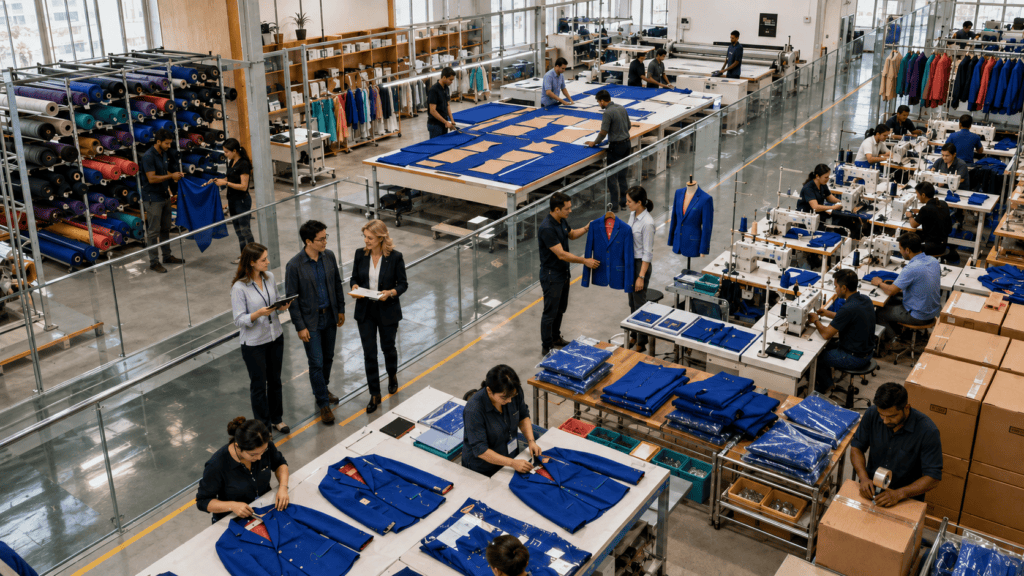
A live factory visit or video walkthrough can help, especially when the brand knows what it wants to verify. Seeing the cutting area, sewing lines, material storage, QC stations and packing section usually tells more than a collection of polished factory photographs.
The point is not to prove that every production step must happen under one roof. It is to make the supply chain visible enough that the brand knows who is responsible for the product and whether the claimed manufacturing capability can actually be demonstrated.
Check Whether Their Experience Matches the Product
A factory may have years of apparel experience and still have limited experience with the particular product a brand wants to make. Custom clothing manufacturing often requires specific experience with the relevant fabrics, construction methods and finishing processes. Producing basic jersey T-shirts, for example, does not automatically demonstrate the same capability required for structured outerwear, technical garments, complex washes or products with specialized trims.
Instead of asking whether a manufacturer has made “similar clothing,” I would ask for specific examples. Which product categories are produced regularly? What fabrics and constructions does the team work with most often? Are the relevant sewing, finishing or decoration processes part of normal production, or would they be new for this order?
Previous work can help, but finished product photos only show part of the picture. Production examples, material knowledge and a clear explanation of how a comparable garment was made can tell a brand much more than a gallery of finished product photos.
There is nothing inherently wrong with a manufacturer taking on a new type of product. Problems arise when a brand assumes the factory already has experience with something it is actually developing for the first time.
Demonstrated capability is therefore more useful than a broad claim that a factory “can make anything.” A manufacturer does not need to specialize in only one category, but it should be able to explain how its existing production experience relates to the product being discussed.
Use the Sampling Process as a Test
Sampling is one of the first stages where a brand can observe how a manufacturer works rather than simply listen to what it promises.
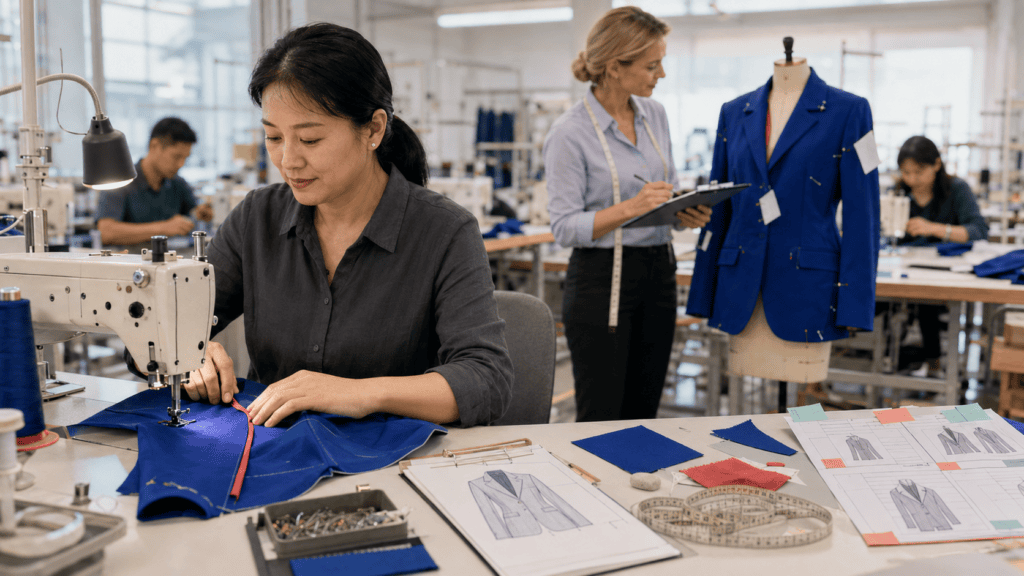
The sample itself matters, of course, but the process around it can be just as revealing. A careful manufacturer should be able to identify missing information, question unclear specifications and keep track of revisions as the garment develops. If the same correction disappears between sample rounds, or an approved detail returns in a different form without explanation, that tells the brand something about how information is being controlled.
Different samples may also answer different questions. Fit, decoration, materials and final pre-production approval do not always need to happen in a single step. What matters is that each decision is documented clearly enough to carry into production.
By the time a pre-production sample is approved, important details such as fit, construction, materials, decoration, labels and packaging should no longer depend on memory or interpretation. Written comments, specifications and agreed tolerances create the reference that bulk production can then be checked against.
This is why I would treat sampling as more than product development. It is also an early test of whether the factory can turn feedback into a controlled production standard.
One Good Sample Is Not the Same as Consistent Production
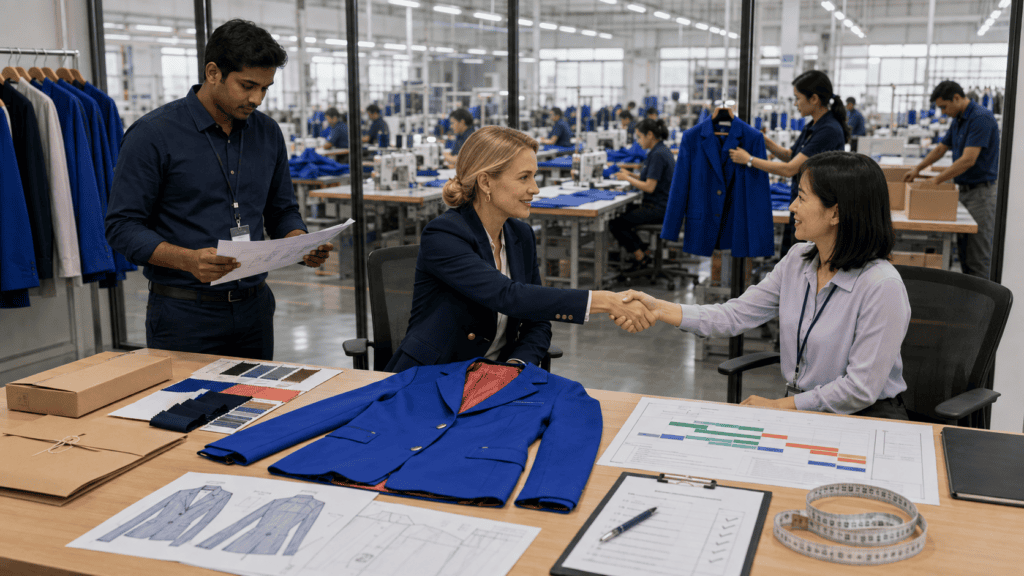
A strong sample is encouraging, but it proves only that the manufacturer was able to make that garment successfully.
Bulk production introduces a different challenge. The approved result has to be repeated across multiple pieces, sizes and sometimes colors while measurements, construction, workmanship and appearance stay within the agreed standard.
Garment inspection procedures reflect that difference. Finished pieces may be measured against specifications and tolerances, while style, color, workmanship and other details are compared with approved references. Quality checks can also take place during production rather than waiting until every garment is finished.
That distinction is important because an excellent sample can receive far more individual attention than a production run. Reliability begins to show when those approved details can be reproduced consistently across hundreds or thousands of units.
For a brand, the useful question after sample approval is therefore not simply, “Do we like this sample?” It is also, “What will make sure production continues to match it?”
Ask How Changes and Approvals Are Recorded
As a garment moves through development, small decisions begin to accumulate. A measurement changes, a trim is replaced, artwork shifts position, or the fabric choice is updated after a sample review. None of those changes is unusual, but they become risky when the approved version is not clearly recorded.
Good documentation does not need to be complicated. What matters is that the factory and the brand are working from the same current information: the latest tech pack, written sample comments, approved measurements, material references, tolerances and packaging requirements.
Problems often appear when several versions of the same product are circulating at once. One person may be looking at an older measurement chart while another is working from the latest sample comments. A detail that seemed settled can then show up incorrectly in the next sample or, worse, during bulk production.
For me, this is one of the less glamorous signs of a reliable clothing manufacturer. Clear files, dates, approvals and version control may not be impressive in a sales presentation, but they make production much easier to manage.
Before bulk begins, a brand should be able to answer a simple question: which exact version of the product has been approved for production? If that answer is unclear, the factory is being asked to reproduce something that has not been fully defined.
A Reliable Timeline Should Have More Than One Date
Lead time is often presented as a single number. A supplier may quote 30, 45 or 60 days, but that number means much more when the brand understands what has to happen during that window.
Material sourcing may need to be completed before cutting can begin. Production capacity has to be available at the right time, and sewing still needs to be followed by finishing, inspection, packing and shipment preparation. Delays at one stage can affect everything that comes after it.
Instead of focusing only on the final delivery date, I would ask for the main production milestones. When are materials expected to arrive? Has the production slot already been confirmed? At what stage will cutting and sewing begin, and when is the order expected to move into inspection and shipment preparation?
A detailed schedule does not guarantee that nothing will change, but it makes delays easier to spot and understand. If fabric arrives late, for example, both sides can see which later dates are likely to move instead of discovering the problem only when the original shipment date is missed.
Manufacturers that give realistic timelines may sometimes appear less attractive than suppliers willing to promise the fastest possible turnaround. In practice, a cautious answer supported by an understandable production plan can be more valuable than an ambitious date with no explanation behind it.
Find Out What Happens When Something Goes Wrong
No production system is completely free from problems. Materials can arrive late, a color can fail approval, measurements may drift during sewing, or an inspection can uncover defects that need correction.
Reliability becomes much easier to judge when a manufacturer can explain what happens next.
It helps to ask what the factory would actually do in those situations. Who informs the brand if a material delay affects production? What happens if an inspection finds a repeated defect? Can faulty pieces be reworked before shipment? Who approves a substitute trim if the original one becomes unavailable, and how is the change documented?
The timing of that communication matters as much as the solution itself. A problem reported early may leave several workable options. The same issue discovered just before shipment can become far more expensive.
I would be more comfortable with a manufacturer that explains risks clearly than with one that insists everything will always go according to plan. Problems are part of manufacturing. What matters is whether the factory catches them early, tells the brand what is happening and fixes them before they become bigger problems.
Quality Control Needs to Be Specific
A supplier saying “we have QC” does not tell a brand very much. The useful question is what gets checked, at which stage, and against which standard.
Some problems are easier to catch while production is still underway. Measurements may begin drifting, stitching can become inconsistent, or a construction detail may be interpreted differently across the line. Finding that early gives the factory a chance to correct the process before the same issue appears across the entire order.
Final inspection serves a different purpose. At that stage, finished garments can be checked for measurements, workmanship, color, trims, labels, packaging and other requirements defined for the product. Depending on the order, inspectors may also compare style and appearance with the approved sample and verify that measurements remain within agreed tolerances.
For a brand, this means quality expectations should be specific before production starts. Which measurements are critical? What tolerances are acceptable? Which sample or specification will inspectors use as the reference? How are defects classified, and what happens when the result is outside the agreed standard?
A reliable clothing manufacturer should be able to explain that process without reducing it to a promise that someone will “check everything” before shipment. The more clearly quality is defined in advance, the less room there is for two sides to discover later that they had very different ideas of what acceptable production meant.
Check the Documents Before the Deposit
By the time a deposit is requested, the commercial details of the order should already be fairly clear.
A quotation is only one part of that picture. The brand should also understand what product specification the price is based on, which materials and trims are included, the agreed MOQ, payment terms, expected lead time, packaging requirements and any development or production costs that sit outside the unit price.
Problems often appear when those details remain vague. A fabric that was assumed to be included may turn out to require a separate minimum. Packaging can change the final cost. A modification discussed during sampling may never make it into the production specification.
This is why I would look closely at how a manufacturer handles paperwork before money changes hands. Do the documents reflect the latest decisions? Are revisions easy to identify? Can both sides point to the same approved specifications and commercial terms?
None of this requires an elaborate corporate system. Even a relatively small supplier can keep clear quotations, approvals and production records. What matters is whether important decisions remain traceable once the project moves from conversation into production.
Verify Certifications Instead of Collecting Logos
Certifications can provide useful information about a supplier, but only when the brand knows what a particular certification actually confirms.
A logo in a presentation is not enough. If a manufacturer claims to hold a certification that matters to the project, the next step is to verify the certified entity, its current status and the scope covered. Some certification schemes provide official databases where buyers can search suppliers and see information such as product categories or certified activities.
That distinction matters because a company name appearing in a database does not automatically mean every facility, process or product connected with that company falls under the same certification.
I would therefore treat certification as one piece of evidence rather than a shortcut for evaluating the entire manufacturer. A valid certification may confirm an important standard or part of the supply chain, but it does not replace sample approval, production controls, inspection or the supplier’s actual performance.
If the certification is genuine and relevant to the project, the manufacturer should be able to provide enough information for the brand to verify it independently.
References Are Useful Only If You Ask the Right Questions
A supplier reference can be useful, but a simple “Were you happy with the factory?” rarely tells a brand very much.
People tend to remember the overall relationship rather than the operational details that matter most during production. A better conversation focuses on what actually happened. Were orders completed when expected? Did bulk production stay consistent with the approved sample? How were defects or delays handled? Did the same problems keep returning on repeat orders?
The answers do not need to describe a perfect relationship. In fact, talking to a previous customer can be most useful when they can explain how the manufacturer responded to a real production problem. That tells a brand far more than a generic statement that the supplier was “good to work with.”
It also helps to ask whether that customer worked with the factory on products comparable to yours. Experience producing simple basics does not necessarily reveal how the same factory performs with technical fabrics, complex trims or tighter construction requirements.
For me, references are most useful when they add context to the evidence already collected. They should support what the factory has shown through samples, documentation and production capability rather than replace those checks.
Factory Visits and Video Calls: What to Actually Look At
A factory tour can create a strong impression, especially when the facility is large, clean and busy. What matters, however, is not simply seeing a working factory.
Brands should know what they want to verify before the visit starts. That might include the cutting area, current sewing lines, raw-material storage, QC stations, finishing, packing or equipment required for a specific product. If embroidery, washing or another important process is subcontracted, the brand can also ask where that work happens and how it is controlled.
Live video can be useful when an in-person visit is not practical. Unlike a polished promotional video, a live walkthrough gives the buyer an opportunity to ask for specific areas or processes to be shown in real time.
What matters is whether the visit answers practical questions. Does the facility appear capable of handling the product being discussed? Are the relevant operations actually visible? Is the workflow consistent with what the supplier described earlier?
A visit does not need to become an investigation. Its value is that it gives the brand a chance to verify some of the manufacturer’s claims firsthand.
Red Flags Matter More When They Form a Pattern
Very few warning signs prove on their own that a manufacturer is unreliable.
An unusually low quote may have a reasonable explanation. A delayed reply can happen during a busy production week. Even a sample error does not necessarily mean the factory cannot handle the order.
Concern grows when several signals begin pointing in the same direction. Production dates keep changing without clear explanations, sample corrections disappear between rounds, requested documents remain vague, or the supplier avoids direct questions about subcontracting and capacity.
Patterns matter because they show whether a problem is isolated or part of the way the supplier normally operates. One mistake can be corrected. Repeated confusion around the same type of issue is much harder to dismiss.
I would pay particular attention when promises become more confident as the supporting evidence becomes weaker. A manufacturer should not need to compensate for missing information with stronger assurances.
Use the First Order as a Controlled Test
The first production order can tell a brand more about a manufacturer than weeks of preliminary conversation.
There is no need to make that first order artificially small or simple just for the sake of testing the supplier. Working with a low MOQ clothing manufacturer can make a smaller initial production run practical, but the order should still reflect the product the brand actually intends to scale. The process should remain measurable enough to show where the manufacturer performs well and where problems begin to appear.
Before production begins, the approved product standard, major milestones and quality expectations should already be clear. During the order, the brand can then watch whether updates arrive when expected, changes are tracked correctly, inspections follow the agreed criteria and shipment preparation stays on schedule.
The final product is only part of the result. A shipment can arrive looking acceptable while the process behind it was chaotic, poorly documented or dependent on last-minute corrections. That may become a much larger problem when order volume increases.
I think the first order is therefore best viewed as both a purchase and a test of the production system. The question is not only whether the garments arrived, but whether the manufacturer handled the order in a way the brand would be comfortable repeating at a larger scale.
Questions to Ask Before Paying a Deposit
By the time a brand is ready to pay a deposit, most of the important production questions should already have clear answers.
The exact questions will vary by product, but these are worth clarifying before production begins:
- Who will physically manufacture the order?
- Are any stages of production going to be subcontracted?
- Which production milestones will be confirmed along the way?
- How will sample changes and specification revisions be recorded?
- What becomes the final bulk production standard: an approved sample, specification, or both?
- Before shipment, which quality checks will be completed?
- If an inspection finds a repeated defect, what happens next?
- In the event of a delay, how will the brand be informed?
- Can the production facility and relevant capabilities be verified?
- Before production begins, which documents will be finalized?
Clear answers do not remove every production risk, but they show whether the supplier has a workable plan for the parts of the order that matter most.
I would also pay attention to how those answers are given. A manufacturer that can explain its process clearly, acknowledge where uncertainty still exists and document the next step usually gives a brand more to evaluate than one that answers every question with an immediate “yes.”
What Reliability Looks Like After the First Order
Reliability becomes easier to judge once there is actual performance to compare with the original promises.
A single successful shipment is useful, but it is still only one data point. Over several orders, patterns begin to emerge: whether deadlines remain realistic, whether defect levels stay under control, whether the same production issues return and whether corrective actions lead to visible improvement.
Supplier performance can be tracked with a few practical metrics. Inspection failure rates, defect trends, right-first-time performance and on-time order completion are all examples of measurable indicators that can show whether production is becoming more predictable over time.
Not every brand needs a formal supplier scorecard. Even simple records can reveal a great deal: Was the order ready when expected? Did bulk production remain consistent with the approved standard? Were the same corrections needed again? How much intervention was required from the brand to keep production on track?
For me, this is where trust starts to come from actual performance rather than promises. The manufacturer is no longer being judged mainly on what it says it can do, but on what repeatedly happens when real orders move through the system.
Consistency does not mean that every production run must be completely problem-free. A more realistic sign of reliability is that problems become visible early, are handled in a predictable way and do not keep returning without explanation.
Conclusion: Trust the Process You Can Verify
A reliable clothing manufacturer is not necessarily the factory with the biggest facility, the fastest quotation or the most confident sales presentation.
More useful evidence appears in the production process itself: how specifications are controlled, how samples are approved, whether the facility and capabilities can be verified, what quality checks take place and how the supplier responds when something changes.
Some of that evidence can be collected before the first deposit. More becomes visible during sampling and the first production order. Repeat orders then show whether the same standards, timelines and communication can be maintained consistently.
For a brand, that makes reliability less about instinct and more about observation. The question is not whether a supplier can promise that production will go smoothly, but whether enough of the process is visible to understand how the order will actually be managed.
By that point, the brand has something much more useful than a promise: a clearer idea of how the manufacturer works when real production is underway.
FAQ
How can I tell if a clothing manufacturer is reliable before placing an order?
Look for evidence beyond fast replies or a professional presentation. Verify the production facility, ask how samples and revisions are controlled, understand the quality inspection process, review documentation, and confirm which parts of production are handled in-house or subcontracted.
Should I visit a clothing factory before working with them?
A factory visit can be useful, but it is not always necessary. A live video walkthrough, independent factory audit, production samples and third-party inspections can also provide useful evidence when an in-person visit is not practical.
Does a good clothing sample mean bulk production will be consistent?
Not necessarily. A sample shows that the manufacturer can produce one approved garment. Bulk production requires that the same measurements, construction, materials, workmanship and appearance remain consistent across the full order.
What should I check during clothing production?
The exact checks depend on the product, but brands commonly monitor measurements, workmanship, construction, materials, trims, labeling and packaging. Quality inspections can also take place during production, not only after the order is finished.
Are clothing factory certifications enough to prove a manufacturer is reliable?
No. Certifications can verify specific standards, facilities, activities or product categories, but they do not replace sample approval, production controls, quality inspection or a supplier’s actual delivery history.
How do I evaluate a manufacturer after the first order?
Compare what was promised with what actually happened. Useful indicators include on-time completion, defect levels, sample-to-bulk consistency, the number of repeated problems and whether corrective actions resulted in improvement.