
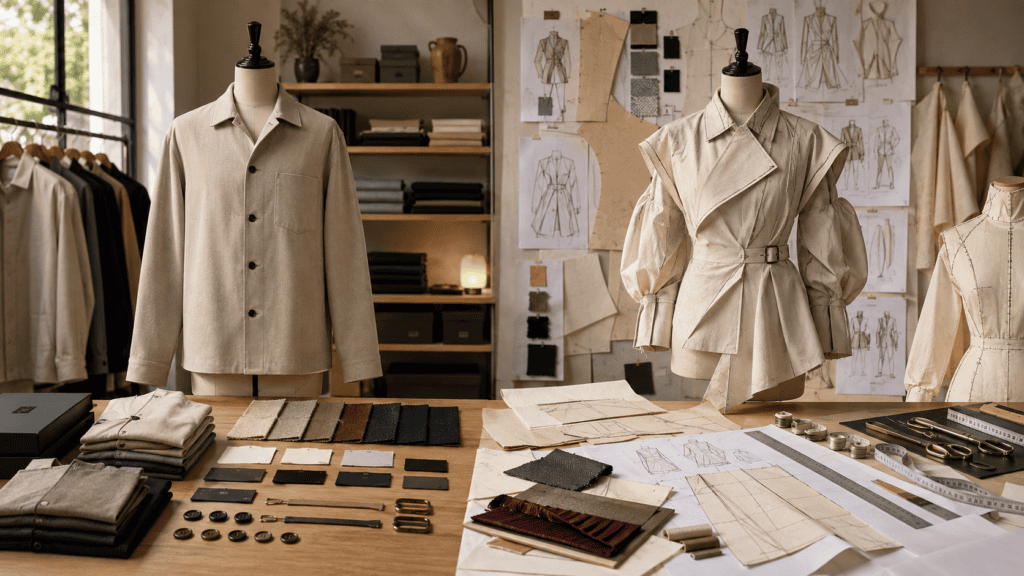
A brand can contact several clothing manufacturers with what sounds like the same request and receive completely different answers. The difficulty is that these terms are not always used in exactly the same way across the apparel industry.
At Fashion Atlas Group, we run into this confusion quite often. A brand may ask for private label clothing manufacturing while expecting a level of product development that another manufacturer would consider fully custom. Suppliers can also use the same term for very different services.
One factory may offer an existing garment that can be relabeled and packaged under the brand’s name. Another may allow changes to the fabric, fit, color, or trims while still describing the project as private label. In a more development-heavy setup, the manufacturer may expect a full tech pack, measurements, construction details, and several rounds of sampling before production can begin.
Even with those differences, the same familiar terms — private label, custom clothing, or custom manufacturing — may still appear in the conversation.
I think this distinction matters because the wrong assumption at the beginning of a project can affect almost everything that follows: development time, sampling, minimum order quantities, cost, production risk, and ultimately how much control the brand has over the finished product.
The more useful question is not simply whether a manufacturer calls a service private label or custom. It is how much of the product already exists before the brand enters the process, and how much still has to be developed specifically for that brand.
Once that is clear, the difference between the two production models becomes much easier to understand.
What Private Label Clothing Manufacturing Usually Means
Private label clothing usually starts with a product that the manufacturer already knows how to make. In practice, that may mean an existing pattern, a proven construction, or a style that can be adapted for a particular brand. The amount of customization available depends heavily on the manufacturer.
For one project, the brand may simply choose a fabric, color, labels, and packaging. A more flexible supplier might also allow adjustments to measurements, fit, trims, finishes, or selected construction details. The key point is that the brand is not necessarily developing every part of the garment from scratch.
This is one reason private label can shorten the path to production. Instead of resolving every technical detail from scratch, the brand is working from a product the manufacturer has already developed and knows how to produce. Sampling may still be necessary, especially when fabrics, measurements, or details are changed, but there are usually fewer unknowns to work through.
The problem is that private label is not a standardized production package. Some manufacturers use the term for little more than adding a customer’s label to an existing garment, while others offer substantial product modifications under the same name. Two factories can therefore advertise private label manufacturing and provide very different levels of product control.
I think brands should pay less attention to the label itself and more attention to what is actually included. Before comparing prices or minimum quantities, it is worth understanding which parts of the garment already exist, which parts can be changed, and where the manufacturer considers the limit of private label production to be.
What Custom Clothing Manufacturing Means
Custom clothing manufacturing starts from a different point. Instead of adapting an existing product, the brand is usually bringing a garment that still has to be developed around its own specifications.
That may include the silhouette, measurements, fit, construction, fabric, trims, grading, finishing details, and branding requirements. Depending on the project, the manufacturer may work from a complete tech pack or help translate sketches, references, and product ideas into production-ready specifications.
Because more of the product has to be defined, custom development usually involves more technical work before bulk production begins. Patterns may need to be created or adjusted, materials sourced specifically for the project, and several sample rounds completed before the garment is ready for approval.
Greater control is the main advantage. The brand is not limited to what already exists in the manufacturer’s range and can build the product around its own positioning, customer, and performance requirements.
That control, however, also creates more decisions. A custom project can only move efficiently when those decisions are made clearly enough for the factory to reproduce the garment consistently at scale.
For that reason, I do not see custom manufacturing as simply a “better” version of private label. It is a different production model, and it makes the most sense when the product itself needs to be distinctive enough to justify the additional development work.
Private Label Is Not the Same as White Label
Another source of confusion is the way private label and white label are used almost interchangeably, even though they usually describe different levels of product ownership and customization.
With white label, the product is typically already developed and can be offered to several different businesses. A brand may add its own logo, labels, or packaging, but the garment itself changes very little. The same base product can therefore appear under multiple brand names.
Private label generally gives the buyer more influence over the finished product. Depending on the supplier, that may include choices around fabric, color, measurements, trims, finishing, packaging, or other details that make the product more specific to one brand.
Custom manufacturing goes a step further. Here, the garment is developed around the brand’s own specifications rather than selected from an existing product base.
These models are better understood as a spectrum than as three perfectly separated boxes:
White label → Private label → Custom manufacturing
Moving along that spectrum usually means greater control over the product, but it also means more development decisions, more preparation, and often more responsibility on the brand’s side before production can begin.
The terminology itself matters less than the practical question behind it: how much of the garment is already fixed, and how much can still be changed for your brand?
Before comparing quotations from two manufacturers, I would want that distinction clarified first. Similar-looking offers can give a brand very different levels of control over the final product.
Where the Real Difference Appears: Product Control
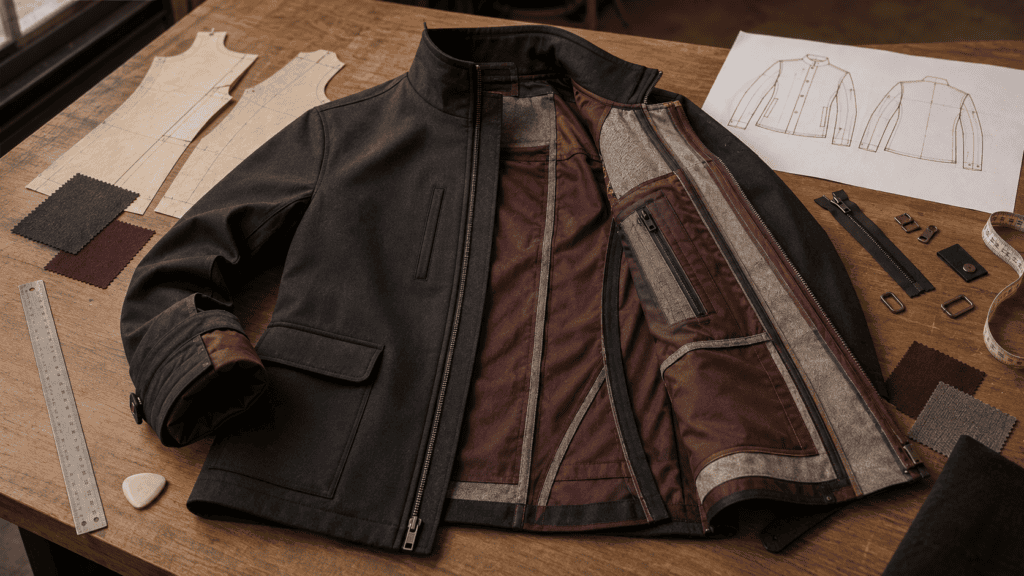
The clearest difference between private label and custom manufacturing usually shows up in the number of product decisions the brand is allowed to make.
With private label clothing manufacturing, some parts of the garment may already be fixed before the project begins. The base pattern, construction method, available fabrics, or standard trims can come from the manufacturer’s existing system. A brand may still have meaningful room to customize the product, but that room has boundaries.
Custom manufacturing gives the brand much more influence over the garment itself. Fit can be built around a specific customer, construction details can be changed, fabrics can be sourced to a particular specification, and trims or finishes can be selected for the intended positioning of the product.
That difference matters because branding and product control are not the same thing. A garment can carry custom labels, packaging, embroidery, and a branded hangtag while still being based on a standard product that is sold in a similar form to other clients.
In my experience, this is where expectations can become misaligned. A brand may believe it is ordering something highly customized because the visual identity is unique, while the manufacturer is working from a largely fixed product platform.
For that reason, it helps to separate branding from product development. A garment can look completely on-brand while very little about its underlying construction has actually changed.
Once those two things are clear, it becomes much easier to understand whether private label offers enough flexibility or whether the product really needs a custom development process.
Development Time: Why Private Label Is Usually Faster
Private label production often moves faster because part of the product development work has already been done before the brand enters the process.
An existing pattern may already be tested, the construction method may be familiar to the factory, and suitable fabrics or trims may already be available within the supplier’s normal sourcing network. Instead of building every technical decision from the beginning, the brand is adapting a product that the manufacturer already understands.
That can reduce the number of sampling rounds and shorten the time needed to reach bulk production. It can also make costing more predictable because fewer unknowns have to be resolved along the way.
Custom manufacturing works differently. New patterns may need to be developed, measurements adjusted, fabrics sourced specifically for the project, and construction details tested through several sample stages. Every new decision has to be tested or confirmed before the factory can move confidently into production.
Speed, however, is only useful when the existing product is already close to what the brand needs. Choosing private label simply because it appears faster can create a different problem if the fit, fabric, or construction never fully matches the intended product.
For me, that is the more useful way to think about development time. Private label can reduce the amount of work required before production, but only when the existing base gives the brand enough of what it actually wants.
MOQ and Cost: The Difference Is More Than Unit Price
MOQ is often discussed as if it were only a pricing issue, but the production model changes much more than the final cost per garment.
In private label production, some development work has already been absorbed into an existing product. Patterns may be established, construction methods are familiar, and standard fabrics or trims may already be available. This can make smaller production runs easier to organize because the factory is not starting from zero.
Custom manufacturing can involve a different cost structure. New patterns, grading, sample development, custom fabrics, special trims, dyeing, printing, or finishing may each introduce their own minimums before bulk production even begins.
A lower unit price therefore does not always mean a lower overall commitment. One factory may quote an attractive production cost but require larger fabric minimums, more development work, or higher quantities per color. Another may appear more expensive per unit while allowing the brand to keep inventory exposure much lower.
I think this is where brands sometimes compare quotations too narrowly. What matters is not only how much one finished garment costs, but also how much cash, development time, and inventory the project requires before those garments can be sold.
For that reason, MOQ should be viewed together with the entire production setup. A model that looks more expensive at first can still make better business sense if it reduces unnecessary stock or avoids development work the brand does not need.
When Private Label Makes More Sense
Private label clothing manufacturing tends to work best when a brand wants meaningful control over presentation and selected product details without developing every technical element from the beginning.
A company may already know the category it wants to enter but have little reason to create a completely new pattern or construction. In that situation, working from an established base can remove development work that would add cost and time without creating much additional value for the customer.
This approach is particularly useful when the brand’s differentiation comes from positioning, graphics, color direction, packaging, distribution, or the way the product is presented rather than from a proprietary garment construction. The product still has to meet the brand’s quality expectations, but its construction does not necessarily need to be unique.
Speed can also matter. A retailer testing a new category, an established brand adding an adjacent product, or a smaller company validating demand may benefit more from getting a well-developed product to market efficiently than from controlling every construction detail.
Private label can also reduce the number of early decisions a team has to make. Instead of resolving pattern development, grading, construction methods, and material sourcing all at once, the brand can concentrate on the elements that are commercially important to that particular launch.
I would not choose private label simply because it appears easier, though. It makes sense when the existing product platform is already close enough to the intended result that the limitations do not weaken the brand’s offer.
The useful question is therefore not whether a company can develop something custom. It is whether doing so would create enough additional product value to justify the extra work.
When the Product Needs More Control
Custom manufacturing becomes the stronger option when the product itself is expected to carry a meaningful part of the brand’s differentiation.
A distinctive fit, unusual construction, technical function, proprietary fabric specification, or very specific design language can be difficult to achieve by adapting an existing base style. In those cases, the limitations of private label may begin to matter more than the speed it offers.
Product categories can also influence the decision. Performance garments, structured pieces, uniforms, technical outerwear, or products with specialized trims and functional details often require more control over construction than a standard private label program can provide.
Another reason to choose custom manufacturing is consistency across future production. If a brand expects to reorder the same product for several seasons, refine the fit over time, or build a recognizable core style around that garment, investing in a product developed around its own specifications can make more sense than repeatedly adapting someone else’s base.
The additional development work should still have a clear purpose. Creating a new pattern, sourcing a special material, or adding a custom construction detail only makes sense if that difference contributes something the customer can feel, see, use, or value.
This is where custom manufacturing becomes easiest to justify: when the product itself is part of the reason the customer chooses the brand.
In that situation, greater control is not simply an extra production feature. It becomes part of the commercial value of the product.
The Question Brands Should Ask Before Choosing
The decision becomes much clearer when a brand stops asking which model is “better” and looks instead at what actually makes its product different.
For some companies, the strongest part of the offer may be the brand itself: the audience, visual identity, graphics, storytelling, distribution, or the way the product is presented. In that case, private label can provide enough product flexibility without adding development work that customers may never notice.
A different brand may compete through fit, fabric performance, construction, functionality, or a recognizable product shape. Here, relying on an existing base can become restrictive because too much of the customer value is tied directly to the garment.
This distinction also helps prevent unnecessary customization. It is easy to assume that more control automatically creates a stronger product, but every additional custom element needs to be developed, approved, sourced, and reproduced consistently in production.
Rather than asking how much a factory can customize, I would ask a more practical question:
Which parts of this product need to be unique for the brand to succeed?
Once those elements are identified, the production model is easier to choose. Everything that genuinely supports the product’s value may justify custom development. The rest does not necessarily need to be reinvented.
Questions to Ask a Manufacturer Before Requesting a Quote
Before comparing prices, it helps to understand what each manufacturer is actually offering under the terms private label or custom manufacturing.
A quotation can look straightforward while leaving important parts of the development process undefined. Two suppliers may offer similar unit prices but include very different levels of customization, sampling, sourcing support, or technical development.
These are the questions I would clarify first:
- When you say private label, what part of the product already exists?
- Can the base pattern be changed, or only the branding and finishing details?
- Can I select a different fabric, weight, composition, or color?
- Are fit measurements adjustable?
- Can trims, hardware, labels, and packaging be customized?
- Is the same base style available to other brands?
- What MOQ applies per style, color, or fabric?
- Which development costs are separate from the unit price?
- How many sample rounds are included before bulk production?
- Who owns the pattern or technical files created for the project?
- At what point does a modification move the project from private label into custom development?
That last question is particularly useful because it often reveals how the supplier itself draws the line between the two models.
Clear answers also make quotations easier to compare. Instead of looking only at price per piece, the brand can see how much development work is included, which decisions remain open, and what additional commitments may appear later.
This is where the terminology becomes practical. The goal is not to force every manufacturer into the same definition. It is to understand exactly what will be developed, what will remain standard, and what the brand is actually paying for.
Conclusion: Choose the Production Model Around the Product
Private label and custom manufacturing are not two versions of the same service. They solve different problems.
Private label clothing manufacturing can be the better choice when an existing product platform already gets the brand close to the result it wants. It can reduce development work, shorten the route to production, and allow the team to focus on the parts of the offer that actually create commercial value.
Custom manufacturing becomes more useful when those important differences sit inside the garment itself. Fit, construction, technical performance, materials, and product-specific details may justify a longer development process when they are central to why the customer will choose the product.
What matters most is avoiding unnecessary complexity in either direction. A brand does not gain much by developing every element from scratch if customers will never value those differences. At the same time, forcing a distinctive product into an existing private label framework can create compromises that remain visible long after the faster launch has been forgotten.
I think the best production decisions usually begin with a fairly simple question: what genuinely needs to be unique here?
Once that is clear, the rest becomes easier to evaluate. The brand can decide where standardization is useful, where customization creates real value, and how much development work the product deserves.
Choosing between private label and custom manufacturing is therefore less about selecting the more advanced option and more about selecting the model that fits the product, the business, and the reason customers are expected to buy it.
FAQ
What is the difference between private label and custom clothing manufacturing?
Private label typically starts from an existing or partly developed product that a brand can customize, while custom manufacturing develops the garment more extensively around the brand’s own specifications.
Is private label clothing cheaper than custom manufacturing?
It can require less development work, but the final cost still depends on MOQ, fabrics, trims, sampling, packaging and the level of customization required.
Which option is better for a clothing brand?
Private label can work well when an existing product is already close to what the brand needs. Custom manufacturing makes more sense when fit, construction, materials or technical features are an important part of the product’s differentiation.